

Guides
Privacy settlements guide: reading a notice
A privacy settlements guide to class notices: what four choices mean, which dates to check, and how to spot claim and follow-up scam warning signs.
This privacy settlements guide is for anyone who received a notice saying they may be a member of a class in a matter about how their information was handled. The notice is long, written for a court rather than for you, and asks you to make a decision by a date.
This page is about that decision. It is general: your own notice is the authority on your own situation, and nothing here is legal advice.
In the United States, class settlements are overseen by a federal or state court, while the Federal Trade Commission and state attorneys general bring many privacy enforcement actions. The settlement administrator named in the notice—often Epiq, Kroll, Angeion, or JND—runs the official website and claim process.
What to take away
- The notice and the official settlement website are the sources. A summary you read elsewhere is not.
- Doing nothing is a choice with consequences, and in many arrangements it is the choice that gives up the most.
- Anyone who contacts you offering to file on your behalf for a share of the money is the thing to be careful about, not the settlement.
Read the notice for four things first
Skip to the parts that decide something. The rest is context.
Who is covered. A class definition is a description of people, usually by what happened to them and when. It is narrower than the headline. If you do not clearly fall inside it, that is the first question to resolve, and the official site usually has a page for it.
What is on offer. Money, a change in practice, free monitoring of some kind, or a combination. Note whether the amount per person is stated or depends on how many people claim.
What your options are. Almost always some version of the four below.
The dates. There is usually more than one, and they are for different things. They are rarely extended.
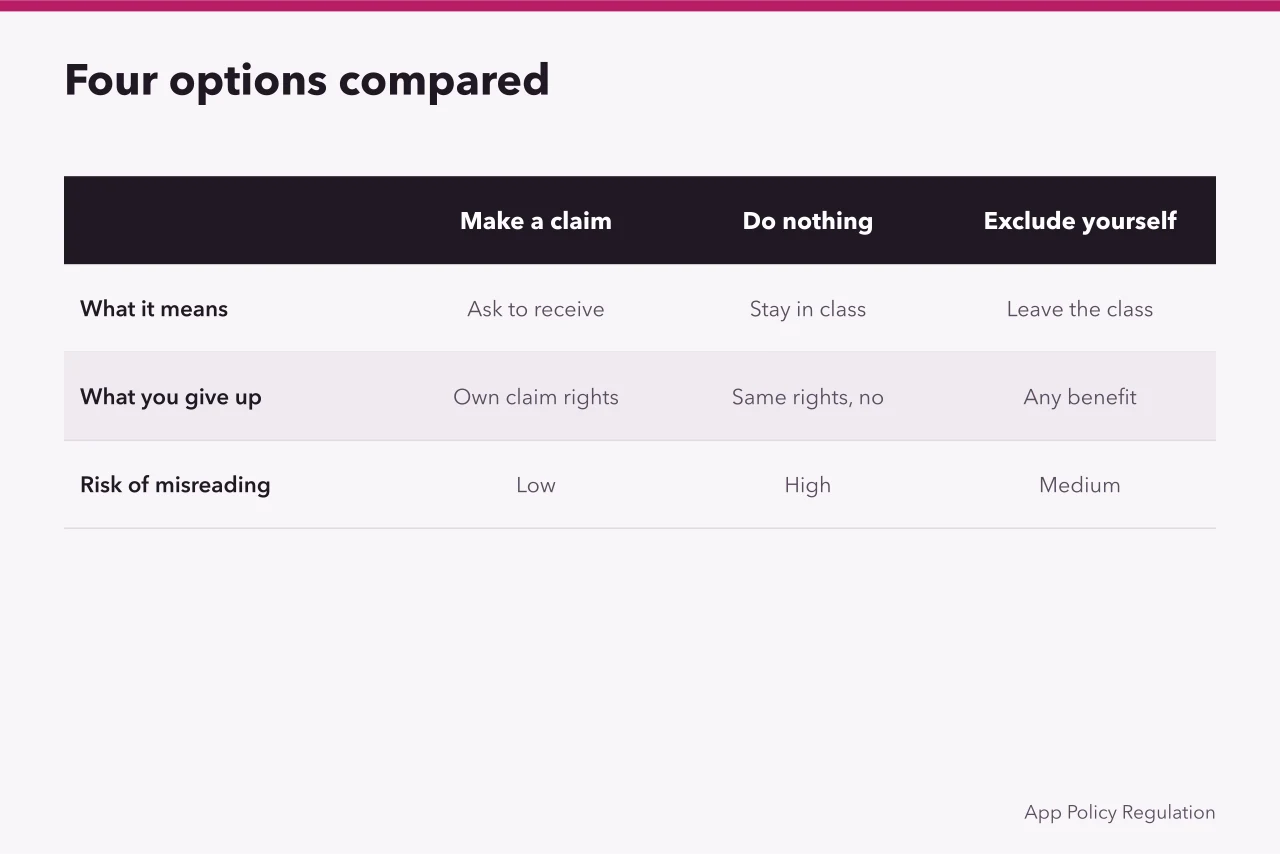
The four options
What it means
- Make a claim
- You ask to receive whatever is on offer
- Do nothing
- You stay in the class
- Exclude yourself
- You leave the class
- Object
- You stay in but tell the court you think the terms are inadequate
What you give up
- Make a claim
- Usually your ability to bring your own claim about the same conduct
- Do nothing
- Usually the same rights, without receiving anything
- Exclude yourself
- Any benefit under this arrangement
- Object
- Nothing directly, though it is not a way to get more for yourself
The row people misread is the second. Doing nothing is not neutral. In many arrangements a class member who does nothing is still bound by the release and simply does not receive the benefit, which is the worst combination available.
The general mechanics of how a class is defined and bound are set out in Cornell Legal Information Institute’s explanation of Rule 23. One court system's own procedural rule on the subject is published at Rule 23 of the Federal Rules of Civil Procedure. In the United States, privacy enforcement actions are often brought by the Federal Trade Commission or a state attorney general, and the class settlement itself is approved by the court named in the notice. Procedures elsewhere differ, sometimes fundamentally, including whether people opt in rather than out.
Exclusion is the decision to think about
Excluding yourself preserves your own claim and costs you the benefit. That trade is only worth making if you have a claim worth bringing, which usually means you suffered something specific and documentable rather than the general exposure everyone in the class shared.
It is also the option with the shortest window and the least reversibility. If the amount at stake matters to you, or you think your situation is unusual, speak to a qualified adviser in your own jurisdiction. Do not decide from a page like this one.
The concept of what makes a claim yours to bring, rather than the class's, is described generally in Cornell Legal Information Institute’s explanation of standing.
Objecting is different from excluding yourself. An objection asks the court to reject or modify the settlement while you stay in the class; it usually has its own deadline and must follow the notice's instructions. It does not preserve your separate claim the way exclusion does.
What the official claim form asks for, and what it should not
A legitimate claim process asks for enough to identify you as a class member and enough to pay you. That can reasonably include your name, contact details, some proof of the relationship (an account identifier, an old email address, a reference from the notice), and payment details at the point of payment.
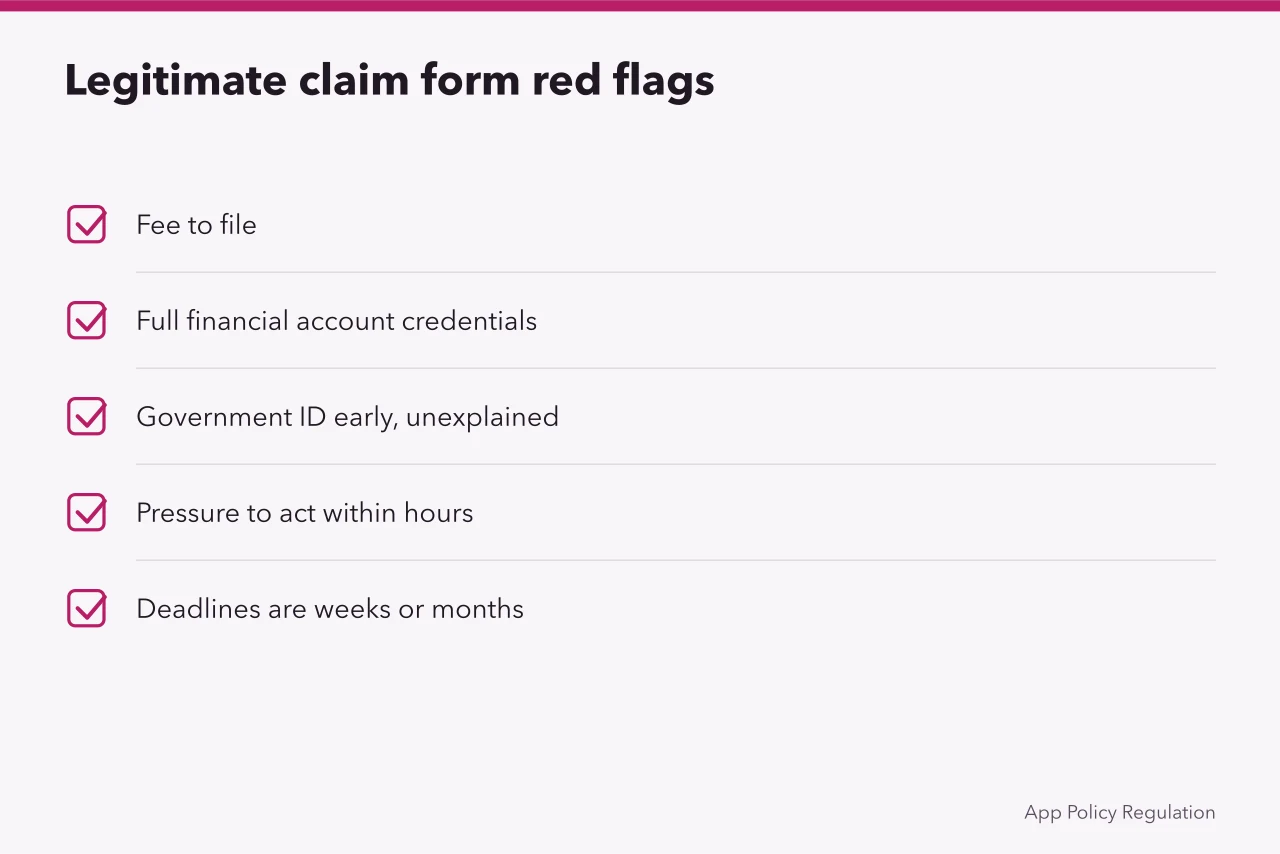
What should make you stop: a fee to file, a demand for full financial account credentials, a government identity number requested early with no explanation of why, or pressure to act within hours. The official claim form and the notice's instructions are the only place to confirm the deadline. Deadlines in these matters are weeks or months. Urgency is a sales technique, not a court's.
The follow-up scam
Publicity about a resolution creates a list of people who are expecting money and have proven they respond to messages about it. That list is valuable to the wrong people, and contact follows.
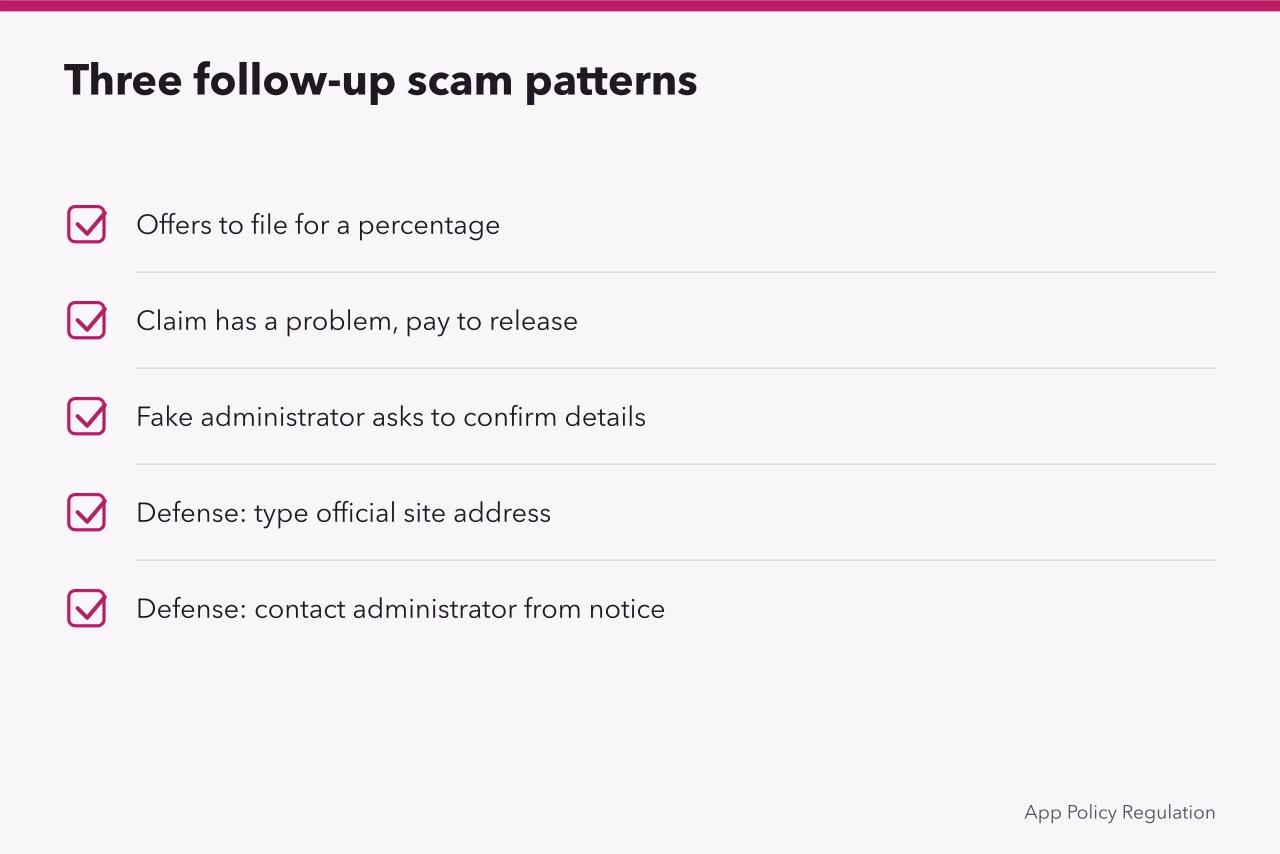
Three patterns worth recognizing. Someone offers to file for you and takes a percentage, for a form you can file yourself for nothing.
Someone says your claim has a problem and needs a payment to release it. No legitimate process asks you to pay to receive money. Someone claiming to be from the administrator—Epiq, Kroll, Angeion, or JND, for example—asks you to confirm details they should already hold.
The defense is boring and works. Go to the official site named in the notice by typing the address, not by following a link in a message. If you are unsure whether a message is genuine, contact the administrator through the details on the notice rather than the details in the message.
If you never received a notice
Not receiving one does not mean you are not covered. Notice programs work through the contact details an organization holds, which are frequently out of date. Where a matter is public, the official site usually has a way to check whether the class definition covers you and to register a current address.
Equally, receiving a notice does not establish that anything was proven. Many resolutions are agreed without any admission, and the court's approval order and the notice itself are where you check what the settlement does and does not establish.
What this does not decide
A resolution about how information was handled does not restore a service, does not reverse an account decision, and does not tell you what a company may do with your information now. Those are separate questions with separate sources.
What a service is permitted to do to your account is in the agreement you accepted. What happens when it acts is in the enforcement outcomes, and in the United States the body that could regulate the conduct is often the Federal Trade Commission or a state attorney general.
Where the information concerns a child, a different set of rules and bodies is usually involved. In the United States, the Children's Online Privacy Protection Act (COPPA) and the Federal Trade Commission are the starting point.
Common questions
How much will I get?
Nobody can tell you from a page. Where a fund is divided among claimants, the individual amount depends on how many claim, and fees, notice costs and administration are typically deducted first. The notice will say how the calculation works; that is the only reliable description.
How long does it take?
Longer than people expect, frequently a year or more after the deadline, because approval, any appeal, and the claims process all take time. Silence for months is normal and is not a sign that something went wrong.
Should I hire a lawyer to file a claim?
For an ordinary claim under a published process, generally no: the form is designed to be filed without one. If you are considering excluding yourself, or your situation involves specific documented harm, that is a different question and worth an hour of proper advice.
Does taking the money mean I agree with the outcome?
It normally means you accept the release, which is the part to read. Agreement with the outcome is not what is being asked; the document is the thing that binds you, and its terms are the ones that matter.