Guides
Fake casting calls and identity verification: the checks that catch them
Fake casting calls now harvest identity documents, not just fees. Here are the checks that catch them, why money direction settles it, and what to do if you paid.
What to take away
- Verify the production company and the named people before you send a tape, a photo or a document.
- Money moving from you toward a production is the reliable sign that something is wrong.
- A casting notice that asks for a passport or Social Security number at first contact is a data grab, not a booking.
- A search that finds nothing is itself a result. Silence about a company is not neutral.
- If you already paid or sent documents, contact your bank and freeze your credit before anything else.
Start with the production, not the offer
An offer is easy to write. A production is hard to fake, because a real one leaves traces in places its author does not control. Ignore the message for a moment and look for the project.
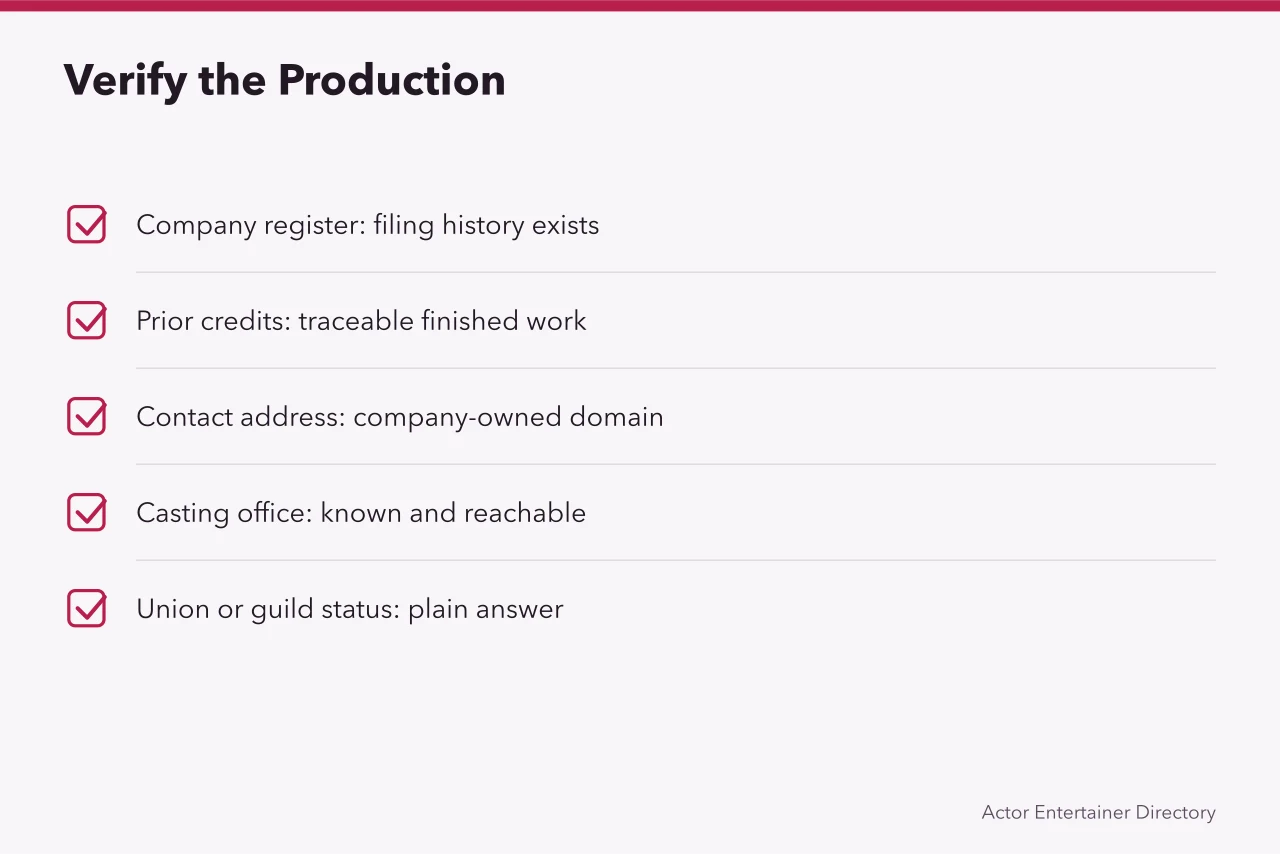
Search the exact title with the word production or casting. Look for the company as a registered business in the public register covering its stated address. Search the named director, producer and casting director against their earlier projects, then check those projects exist independently.
| Check | What you are looking for | What a bad answer looks like |
|---|---|---|
| Company register | The company exists, with a filing history | No record anywhere, or registered last month |
| Prior credits | The named people trace to finished work | Names that appear only in this one message |
| Contact address | A domain that belongs to the company | A free email account, or a near copy of a real domain |
| Casting office | Known and reachable independently | A number that only appears in the message |
| Union status | Whether the production is signed, where that applies | Vague reassurance instead of a plain answer |
Read the message like an editor
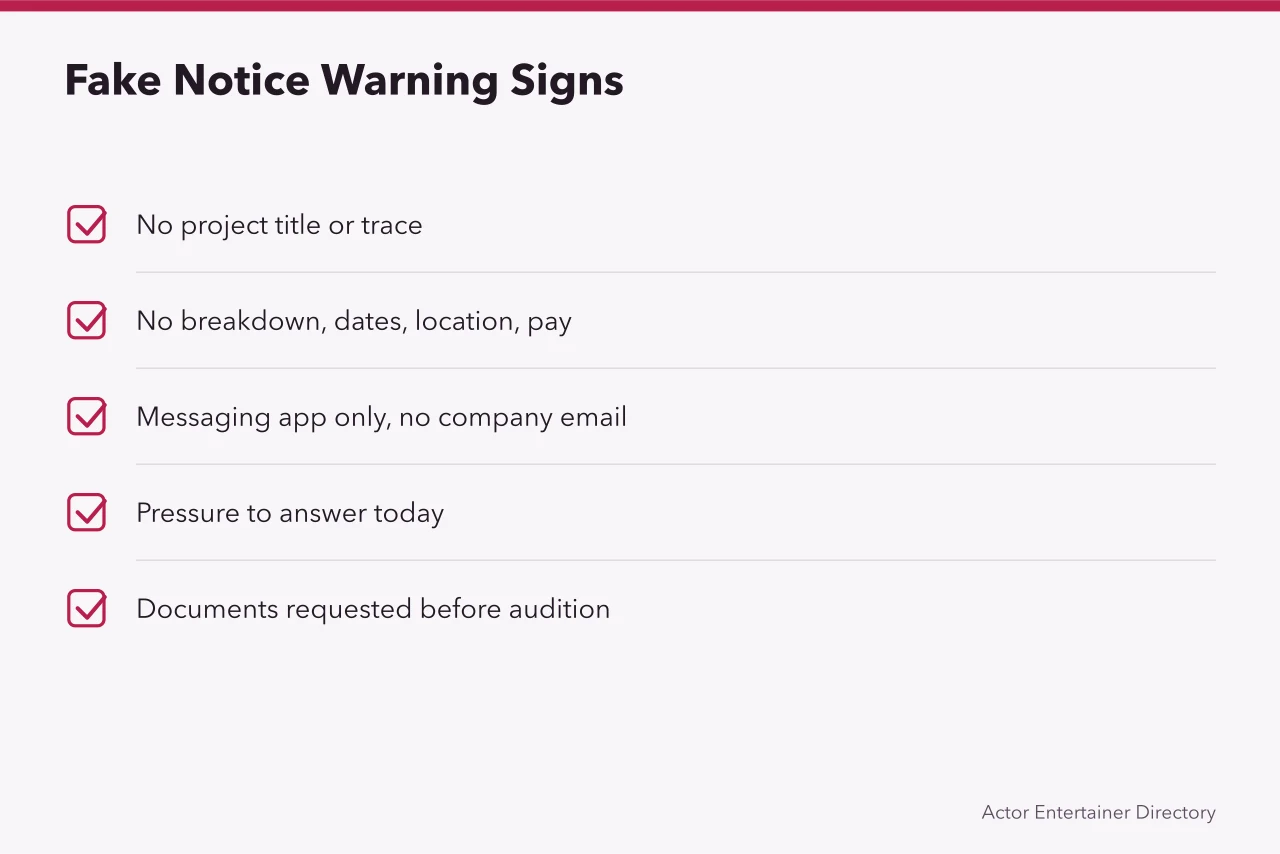
Fake notices share a texture. They are flattering, urgent and vague at once. They praise work they cannot have seen, promise a role rather than an audition, and avoid naming anything checkable.
Watch for the document request. A genuine production collects a passport, a Social Security number or a bank detail at contracting or payroll setup. It does not ask on day one. Federal guidance on identity theft explains how those details get reused once they leak.
Money is the bright line
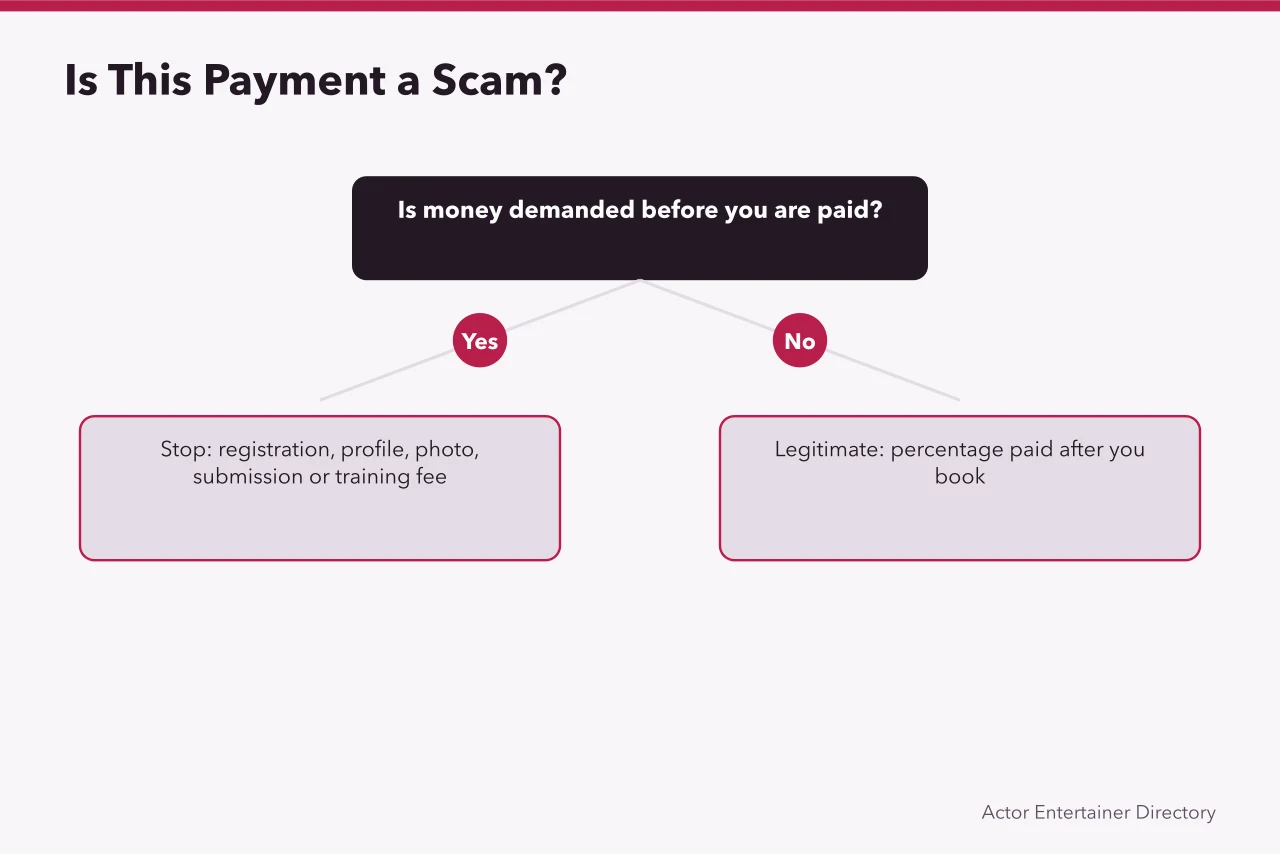
Legitimate representation is paid out of what you book, as a percentage, after you are paid. It is never paid in advance. That one sentence settles most of what confuses people about the edges of this industry.
Treat any of these as a stop:
- A registration fee or a compulsory paid profile
- A mandatory photo session with a named photographer
- A fee to be submitted, or a training package attached to a role
- A deposit for travel or accommodation
- Any payment sent to you with instructions to forward part of it
That last one is a bank fraud. You are liable when the original payment is reversed. The whole family is the ordinary advance-fee scheme fitted to this trade.
When the project is real but the offer is not
A less obvious version uses a genuine production as cover. The film exists, the names are real, and the person contacting you is connected to none of it. Verification has to close that gap too.
Reach the office independently. Find the casting company through a source other than the message, and use contact details you found yourself. If you have representation, let them make the call.
Example: the forwarded-check casting scam
A performer gets a message offering a supporting role on a series that is genuinely in production. The sender names a real casting director. The performer is asked to deposit a check for wardrobe and travel, keep a portion, and wire the rest to a supplier.
The check bounces weeks later. The bank reverses the deposit and the performer owes the full amount. No role existed. The real casting director never sent the message, and the performer's bank details are now in circulation.
What to do if you paid or sent documents
Stop paying. Keep every message, screenshot and receipt. Contact your bank the same day and ask for a recall or a chargeback.
If you sent a Social Security number, request a replacement card and a freeze through the Social Security Administration. Report the fraud to the FTC at IdentityTheft.gov, then tell other performers, because these operations work by reaching people one at a time.
The document side is worth reading properly. Our notes on background check examples that are secretly a data grab show how a copied ID becomes a file someone else sells.
Common questions
Is a paid casting platform a scam?
Not necessarily. In some markets a subscription is the ordinary way to be submitted. Judge it by whether casting offices actually search it, and ask working performers rather than the platform.
They asked for my passport and Social Security number before an audition. Is that normal?
No. Documents belong at contracting or payroll setup, with a company you have already verified. A first-contact request is the point at which the scam turns into identity theft.
What if I already sent money?
Stop paying, keep every message, contact your bank immediately, and report it to the FTC. Then warn other performers in the same casting groups.
How do I check a company that has no online presence at all?
Treat the silence as the answer. A production that cannot be found in a state business register or through anyone's prior credits has not been verified, and the burden stays on the sender. Our impersonation checklist walks through the three passes that catch a borrowed identity before it spreads.