Features
Part of Impersonation runs both ways: protecting your name and your trust in others
Getting impersonation risks right the first time
Impersonation risk sorted by who carries the loss: your contacts, your accounts, your documents, and the slower cost of being a name worth copying.
The person impersonated is rarely the person who loses money. That single fact reorders everything about how to respond.
A copied profile is a tool, and the tool is pointed at the people who trust the name on it. Understanding where the damage actually lands tells you who to warn, what to protect, and which parts of this are genuinely not your responsibility to fix.
What to take away
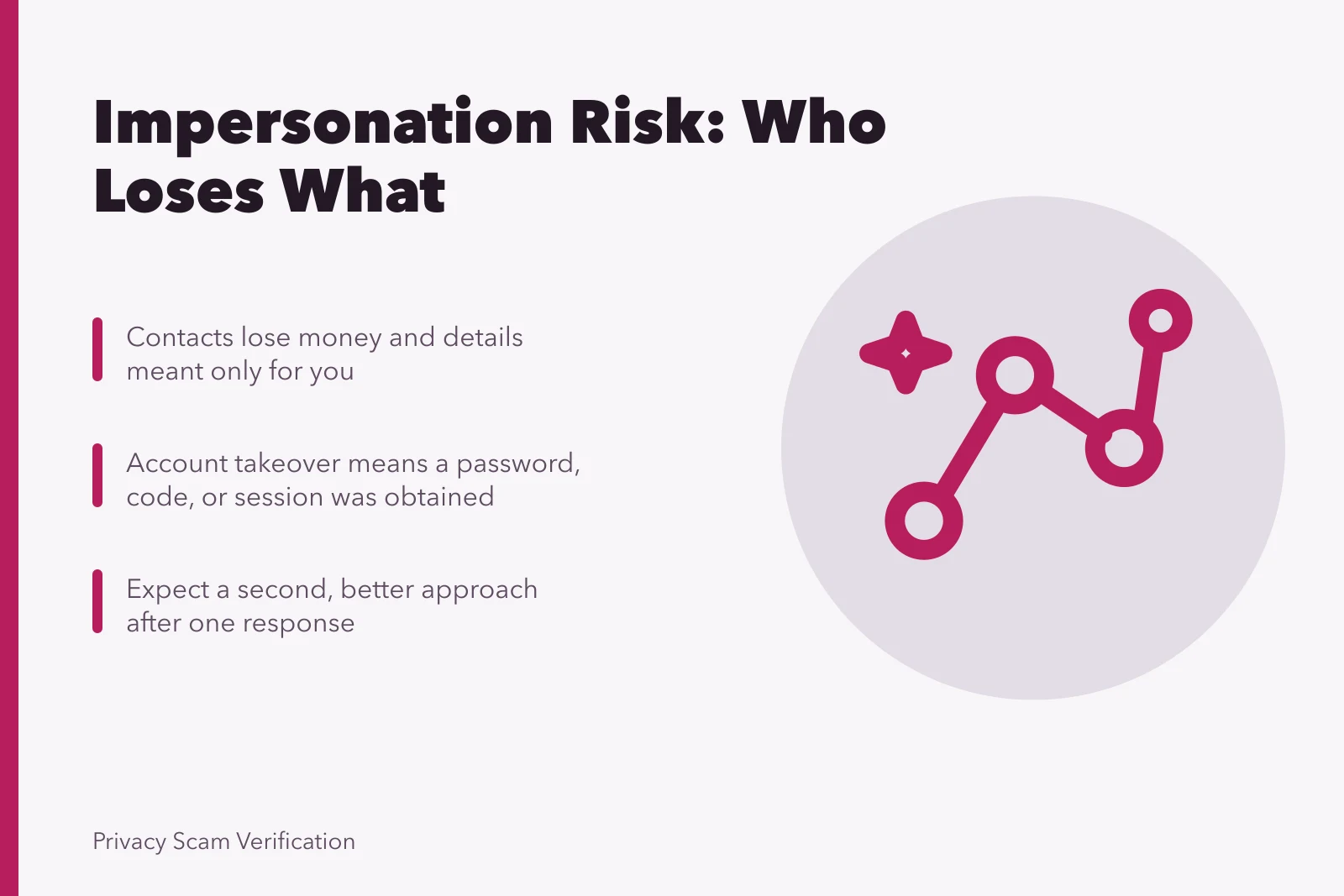
- The financial loss usually lands on a contact, not on the person whose name was used.
- A copy that needs only public photos is a different problem from one that needed your password.
- The durable risk is not the fake account. It is that your name has been shown to work.
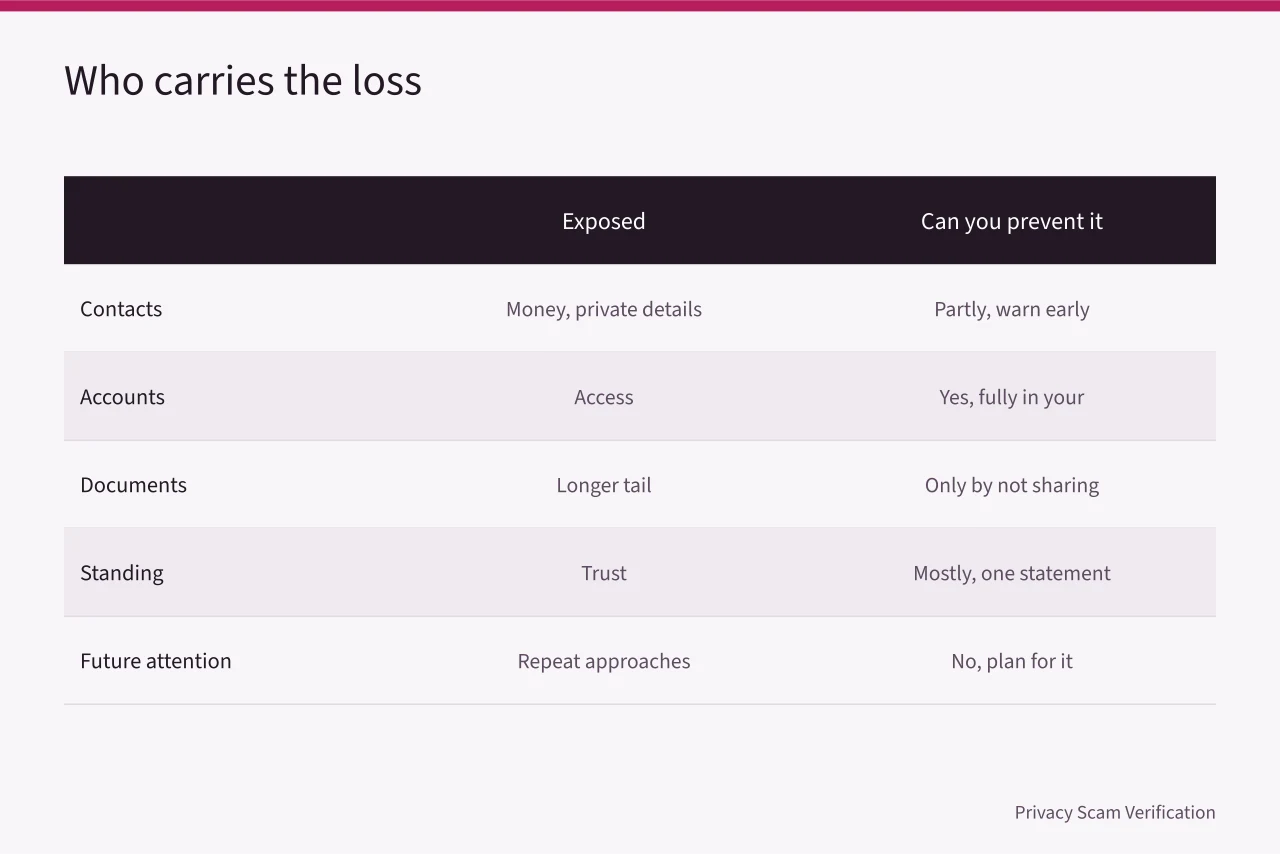
Where the loss actually lands
| Who is exposed | What they can lose | Whether you can prevent it |
|---|---|---|
| Your contacts | Money, and details they would only give to you | Partly, by telling them early |
| Your accounts | Access, if anything was taken to build the copy | Yes, and this is the part fully in your hands |
| Your documents | Nothing yet, but a longer tail if any were shared | Only by not sharing them |
| Your standing | Trust from people who were approached in your name | Mostly, by one clear public statement |
| Your future attention | Repeat approaches, because the name worked once | No. Plan for it instead |
The second row is the only one you control completely, which is why it comes first even though it feels least urgent.
The risk to the people around you
An impersonation account is worth having because of the list of people it can reach. That is the whole economics of it.
These approaches are plain and they work. A request for a small loan, with a reason and a deadline. A link sent as if you had recommended it. A message asking for a code that just arrived on their phone, framed as a favor. A claim that you are in trouble somewhere and cannot talk.
None are sophisticated, and none need to be. The trust does the work, not the message.
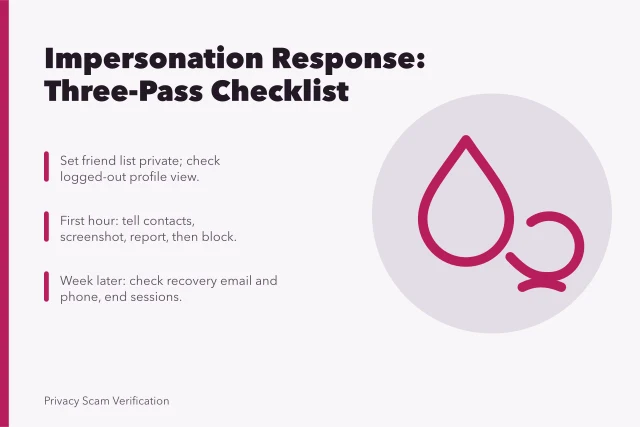
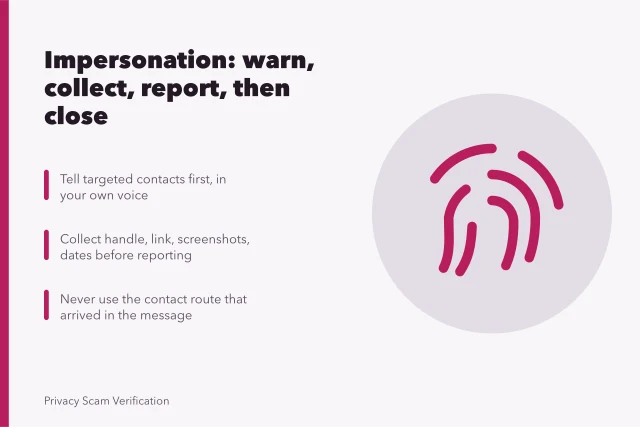
The countermeasure is unglamorous and it is the single most effective thing available to you: tell people, early, plainly, on a channel that is still yours. Warning fifty people badly beats warning nobody perfectly. An impersonation checklist covers what to set up before anything happens and what to do in the first hour.
The risk to your own accounts
Here the question is what the copy was built from.
A profile copied from public photos took nothing from you; it is a nuisance and a reporting job.
A copy that could send messages from your real account is a different event: it means a password, code, or session was obtained.
So did anything leave your hands recently? A code read out to somebody who said they were support, a password typed on a page reached from a message, an approval tapped without reading it.
If the answer is yes, the fake account is the smaller half of the problem. Passwords, sessions, and recovery settings come first, in that order, and the reasoning behind that order is in account security risks.
The risk that arrives later
Being impersonated once puts you on a list of names that produced a response.
Expect a second approach. It will be better than the first because it knows more.
Expect offers of help after an incident: people and services offering to remove the account, trace the person, or restore your reputation for a fee. That is the follow-up scam, reliably. Nobody legitimate approaches you first and charges before anything happens.
The realistic version of what recovery looks like, including the parts that do not resolve, is set out in reporting and recovery.
The risks people overestimate
Two fears absorb a lot of energy and deserve honest sizing.
A copied photograph can open accounts in your name. A photo alone is thin material. Documents, a date of birth, and an address carry that risk.
The advice not to send a passport scan to a stranger matters more than locking down photos. Checks that apply if documents were shared are in identity verification.
The second is that a fake account permanently damages how people see you. In practice one clear statement settles it for almost everyone who matters, and repeated denials do more harm than the original account.
The risks people underestimate
The quiet copy. An account that only posts and never messages looks harmless, and it is building an audience that will be sold or repurposed later. Report it at the point you find it.
Group chats and communities. A copy inside a group you belong to inherits the group's trust rather than yours, and members often do not check names closely in a busy thread.
Voice and video. Short recordings of your voice exist in more places than people think. Treat any urgent request that arrives as audio, from any number, as unverified until you reach the person another way. A prearranged question that only the two of you can answer costs nothing to set up.
Your workplace. If your professional name is being used on colleagues, clients, or suppliers, the exposure is no longer only yours. Reporting late is the part of that which is genuinely your fault.
Sizing your own exposure honestly
Three questions settle most of it, and they take a minute.
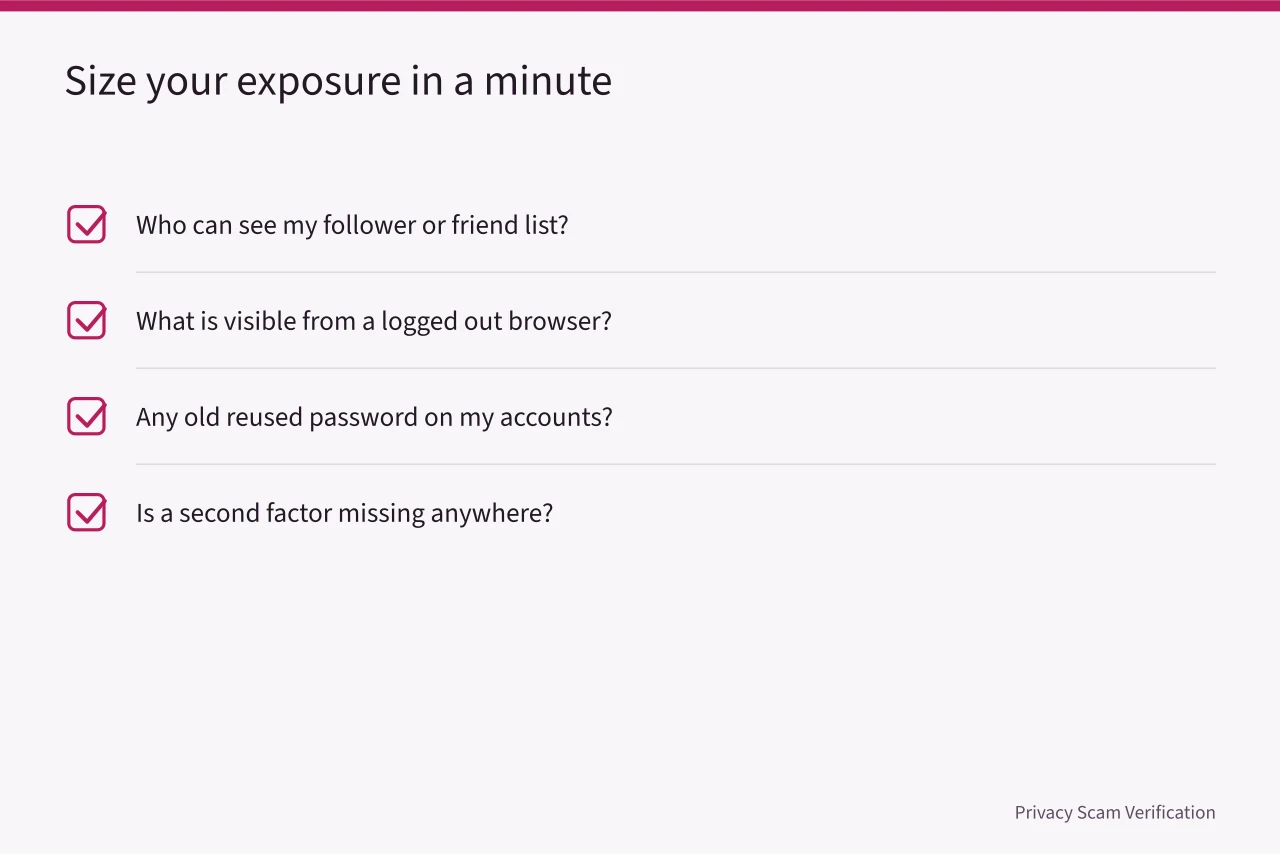
Who can see my follower or friend list, since a copy without an audience is nearly useless? What is visible about me to someone who does not follow me, checked from a logged out browser, not my feed?
Is there anything on my accounts that would let a copy become a takeover? That usually means an old password that was reused somewhere else, or a missing second factor.
Where the answers are uncomfortable, the fix is in settings rather than in vigilance, and the walkthrough is in privacy settings. Reporting routes for the moment it happens, including what to preserve, are collected at the USAGov page on where to report a scam, and the recovery steps for anyone whose details were used are laid out at IdentityTheft.gov.
Common questions
How much of this is my fault?
Almost none of it. Public photos are public, and copying them requires nothing from you. The part that is yours is what happens next: telling people, and closing anything that let a copy become access.
Do I need to warn people if the account has already been removed?
Yes, if it messaged anybody. Removal stops future messages and does nothing about the ones already sent.
Someone impersonated me to a company rather than to a person. What now?
Contact that company directly, using a number you find yourself, and ask them to note it on the account. Keep the reference. This is the case where a written record matters most later.
Is there any way to stop it happening again?
No, and anyone selling you that is selling the follow-up scam. You can make it less useful: a private contacts list, a secured account, and people who know to check with you first.
How long does the risk last?
The account itself is a short problem. Being a name that worked once is an open-ended one, so treat unexpected urgent requests in your name as a permanent feature rather than an aftershock.