Features
Part of Background checks with the guesswork removed (2027 update)
Background check examples: the ones that are secretly a data grab
Background check situations worth recognizing: the ordinary ones, the ones that are really a data collection, and the ones that are a payment request wearing a form.
A background check request tells you something before you answer it. The question is which of three things you are looking at.
Some requests are ordinary and boring, and you should answer them, but others are a way for someone with no reason to hold documents about you to collect them.
A small number are not checks at all but payment or credential requests with a form wrapped around them. The situations below make that difference visible from where you stand.
What to take away
- An ordinary check asks for permission and for identity details. It does not ask for money or access.
- Being asked to verify yourself by somebody who is trying to gain your trust is a collection, not a check.
- The verification requests that arrive during a deal or a relationship are the ones worth the most caution.
Ordinary situations, and what they normally look like
Applying for a job. A consent form that names the purpose, arriving after there is real interest rather than at first contact, asking for full name, dates, and address history. The organization pays. You are told if something in the report counts against you, before the decision is final.
Renting a home. Identity and, depending on where you are, a financial check, run by the agent or landlord with your written agreement. The reasonable version happens after a viewing and before a tenancy, not as a condition of seeing the property.
Volunteering with children or vulnerable adults. Usually a specific scheme, run through the organization, with its own identity process. This one is worth cooperating with fully. If the organization cannot name the scheme, that is the question to ask.
Professional registration. Handled by the body you are registering with, using their own route, on their own domain, reached from a page you found rather than a link you were sent.
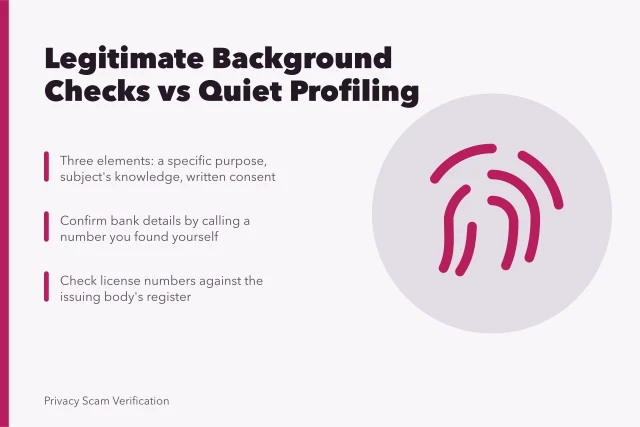
The common thread is that a real organization can tell you what the check is for, who runs it, and what happens next.
Situations that are really a collection
These are the ones that look administrative and are not.
The recruiter who wants documents up front. Contact arrives about a role that sounds close to your experience, moves quickly to a messaging app, and asks for identity documents to get you into the system before any interview. A genuine process collects documents when there is an offer, not to open a file.
The rental that needs a form before a viewing. A property that cannot be seen yet, an application form that wants a date of birth, an address history, and often a payment to hold it. Nothing is being held.
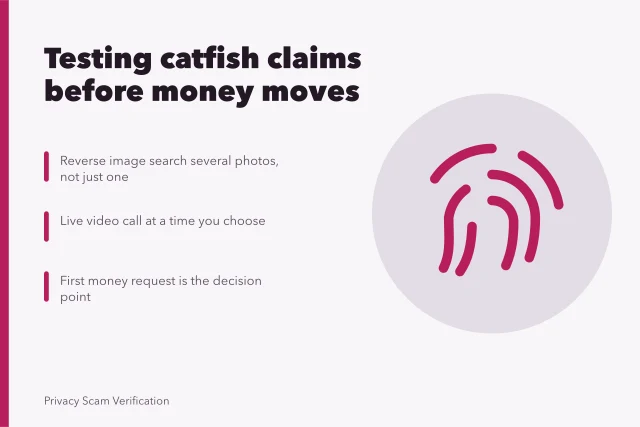
The verification link from someone you met online. A person you have been talking to asks you to verify yourself through a site they send, sometimes framed as their safety rather than yours. Verification you are steered to by the person asking you to trust them is a collection method. The wider pattern for that is in catfishing.
The marketplace buyer who wants ID for a small sale. A private buyer has no reason to hold a scan of your passport for an ordinary sale, and the risk of handing one over is longer-lived than the sale.
In each of these, the request is real, the collection is real, and the check is not.
Situations that are not checks at all
Two shapes, and both are settled without knowing any local rules.
Money vs access requests
Asks for money
- What it wants
- Processing fee
- Other examples
- Deposit to release role
- Also
- Charge to expedite
- Never legitimate
- Hiring does not bill
Asks for access
- What it wants
- Bank login
- Other examples
- Email password
- Also
- Phone code
- Never legitimate
- No check needs this
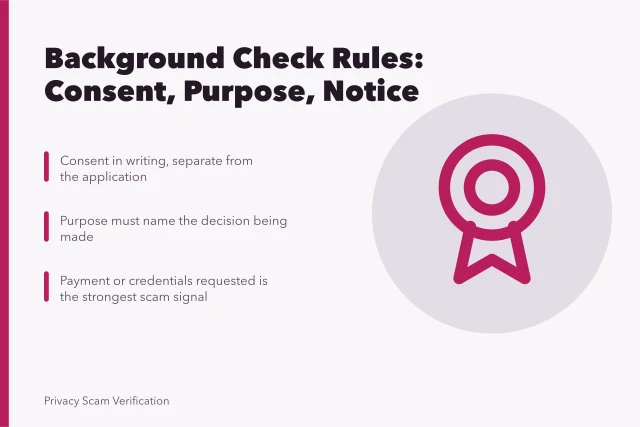
The first asks you for money. A processing fee for your own check, a payment for a certificate, a deposit to release a role, a charge to expedite. Legitimate hiring does not bill applicants for screening, and this is the most reliable single signal in the whole area. The recruitment version is described in the FTC's guidance on job scams.
The second asks you for access. It wants a bank login to confirm income, an email password, a phone code that just arrived on your phone, or an invitation to install software for help completing a form.
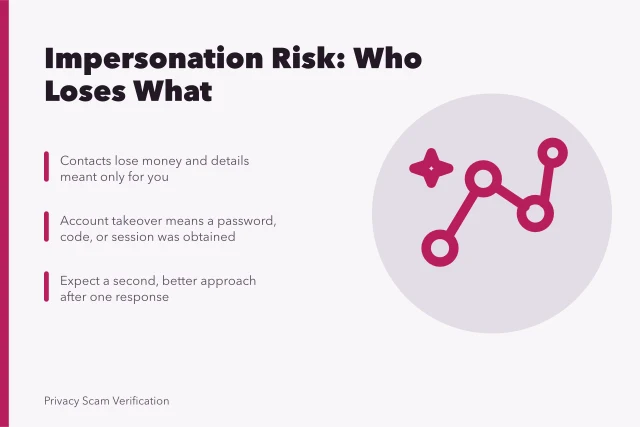
No check needs any of these, ever. If a code was shared, the situation stopped being about a job and became an account compromise; the order to work through is in account security.
The situation people misread
Sometimes a genuine organization does something that looks alarming and is not.
A match on your name is common, not sinister. Matching uses names and dates, so common names collide. A report with an old address you barely remember is common too.
Use the correction route rather than alarm. Its shape is in background checks rules 2027.
The opposite misreading is treating a slow process as a warning sign. Real checks are slow, uneven, and boring. Speed is more often a feature of the fake ones, because urgency is what stops you asking.
A short test you can apply to any request
Five questions, in order. Most requests fail or pass on the first two.
Five-question request test
Does the request want money from me?
stop
continue
Where money has already moved or documents have already gone, the sequence is in reporting and recovery, and the recovery steps for exposed identity details are collected at IdentityTheft.gov.
Common questions
A recruiter asked for my passport before an interview. Is that ever normal?
Rarely. Identity documents belong at the offer stage. Before that, the request is a collection with a plausible reason attached.
I sent documents to what turned out to be a fake employer. What now?
Nothing of yours has been accessed, so this is a monitoring problem rather than an emergency. Watch for applications made in your name rather than for changes to your existing accounts, and keep a record of exactly what was sent and when.
Is it reasonable for a landlord to run a credit check?
In many places yes, with your consent and for a stated purpose. The part to insist on is knowing who runs it and being able to see what it said.
Someone asked me to prove I am real by sending a photo holding my ID. Should I?
No. That image circulates permanently, and it does not prove anything to the person asking. Ask for a video call instead if the point is that you are a real person.
How do I check whether a recruiter is genuine?
Not through the contact details they sent. Find the organization independently and ask whether the role and the person exist, which takes one phone call and settles it.