Features
Part of Verifying a catfishing suspicion before you meet anyone in person
Reading catfishing guide with a sceptical eye
Catfishing handled as four claims that can be checked, one moment that decides everything, and a way to end it without needing to prove you were right.
You will probably never prove who somebody is. That is the wrong target, and chasing it is what keeps people in these situations for months.
A person you have not met makes four claims. They look like the photos, they are where they say they are, they are free to meet, and they are who they say they are.
Three of those claims can be tested cheaply, and the fourth almost never can. This page covers running the cheap tests, then deciding without the expensive one.
What to take away
- Test the claims that are testable, and stop trying to settle identity, which usually cannot be settled from a phone.
- The decision point is the first request for money, and it arrives after a great deal of investment on your side.
- You are allowed to end it without proof, and without an explanation the other person accepts.
The four claims, and what actually tests them
The cheap test
- These are my photographs
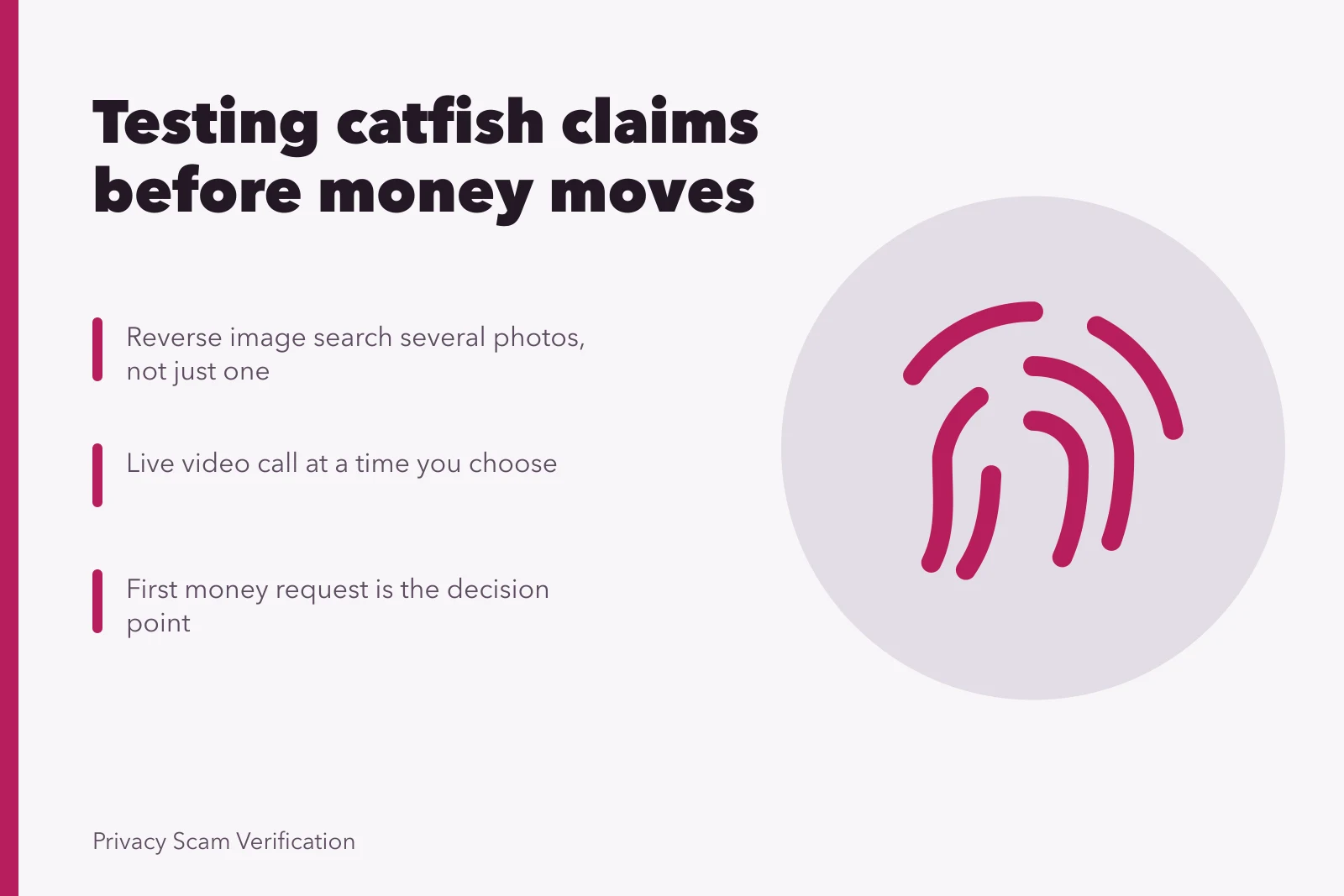
- Reverse image search on several of them, not one
- I am where I say I am
- A live video call, at a time you choose, not one they schedule
- I am free to meet
- An ordinary invitation with a specific date
- I am who I say I am
- Nothing available to you settles this
What a clean result means
- These are my photographs
- Nothing much. An original photograph returns nothing
- I am where I say I am
- Presence at that moment, which is more than any document
- I am free to meet
- The refusal is the result. Watch how it is refused
- I am who I say I am
- Do not spend months here
The second row carries the weight. A short live call, arranged at short notice by you, does more than any amount of message analysis, because it is the one thing a fabricated presence cannot supply on demand.
Four claims and their tests
The claim
- These are my photographs
- Reverse image search, several
- I am where I say
- Live video call, you choose
- I am free to meet
- Ordinary invitation, specific date
- I am who I say
- Nothing settles this
The cheap test
- These are my photographs
- Nothing much
- I am where I say
- Presence at that moment
- I am free to meet
- The refusal is the result
- I am who I say
- Do not spend months
What a clean result means
- These are my photographs
- I am where I say
- I am free to meet
- I am who I say
Asking without accusing
You are allowed to ask. The awkwardness people feel about it is the part that gets used.
Ask directly and lightly, once: can we have a quick video call this evening. Listen to the shape of the answer, not its content. A real person gives an ordinary reason and offers another time.
A fabricated one gives a dramatic reason, a technology reason, or turns the question back on you. That makes asking feel like an insult.
That last move is the one worth naming. If asking a normal question is met with hurt rather than an answer, you have learned something, and you have learned it without accusing anybody of anything.
The moment that decides everything
Money is the point where the situation becomes concrete, and it almost never arrives as a plain request.
It arrives as an emergency, a customs problem, a medical bill, or a temporary account block. It can also be a business opportunity you are included in, or a package needing a fee released. It is often small the first time.
The size is not the signal. The signal: someone you have not met in person needs money to move, and the story requires speed.
The no-money rule, decided in advance
- No money
- No gift card codes
- No cryptocurrency
- No receiving or forwarding payments for anyone you have not met
That last one matters more than it sounds. Passing money for someone else can make you the visible part of their fraud. The person asking knows that.
The pattern behind these requests is set out in romance scams, which covers why the story always needs urgency.
If you have already sent money
First, none of what follows is a judgment. These situations are built by people who do this all day, and they work on cautious people.
Contact your bank or payment provider immediately and say you were defrauded. What can be done depends almost entirely on the payment method and how quickly you call. Stop all payments, including any final one framed as releasing the rest.
Keep everything: the profile, the messages, the payment references. Then report it; the sequence is in reporting and recovery.
Be ready for the second approach. People who have lost money in these situations are contacted afterwards by others offering to recover it for a fee, sometimes referring to the exact amount. Nobody legitimate charges an upfront fee to recover money, and that offer is the second loss rather than the fix.
Ending it
You do not need to win an argument to leave a conversation.
Stop replying. Block them on every channel, including ones you rarely use. Expect several attempts to reopen contact, usually emotional rather than a demand.
Do not send a final message explaining your reasoning; it gives a starting point for the next attempt. Tell one person in your life what happened, in plain words. Isolation is what these situations are built on, and it is the part that lasts after the money.
If images were shared, that is its own problem and it has its own handling, including the rule that paying never ends it. The exposures around that are set out on the catfishing overview.
Protecting the next few months
The clean-up is short and it is worth doing even when nothing was lost.
- Check what a stranger can see on your accounts by looking from a logged out browser, and tighten it in privacy settings.
- Assume the details you shared are now on a list, and expect a better-informed approach later.
- Do not accept new contact from anybody who mentions the incident, including people offering help.
- Keep the records for at least a year, since a reference number is easier to keep than to recreate.
Background on how these approaches are described and reported is in the FTC's guidance on romance scams, and the general term and its history are covered in the Wikipedia article on catfishing.
Common questions
What if I am wrong and this person is real?
Then a video call is a small ask that costs an honest person five minutes, and asking for one is not an accusation. A real person who is briefly annoyed will still take the call.
They agreed to a call but the camera never works. Does that settle it?
It settles the practical question, which is the only one you need. Repeated technical failure at exactly that point is an answer.
Is it catfishing if the photos are real but everything else is not?
The label matters less than the decision. Whether the pictures are theirs or not, the position is the same: an unmet person is asking for money, and the answer is the same either way.
Should I keep talking to gather evidence?
No. Evidence is the messages you already have. Staying in it costs you months and gains a report nothing.
Can I find out who it really is?
Almost certainly not, and the services that promise it charge for a search rather than an answer. That is covered in best romance scams tools 2027.