Rules
Part of Background checks with the guesswork removed (2027 update)
Background checks changes, one decision at a time
Background checks change in three places at once: your own file, the rules where you live, and the scams that borrow the process. Here is how to track each.
Nothing about a background check stays still, and the three moving parts move for different reasons.
Your file changes as records age and new ones attach to your name. Rules change as regulators and legislatures revise them, at their own pace, jurisdiction by jurisdiction.
The fraudulent version changes fastest, following whatever hiring or renting currently looks like. Tracking all three sounds like work, but it takes about twenty minutes a year if you know where to look. The ground it sits on is set out in background checks.
What to take away
- Read your own file once a year. It is the only one of the three you can actually inspect.
- Rules change on their own schedule. Learn which regulator to ask, not a fixed number.
- The fraudulent version changes surface details and keeps the same three requests: money, documents, access.
What changes in your own file
Records age out, disputes resolve, addresses accumulate, and new entries attach to your name, sometimes correctly.
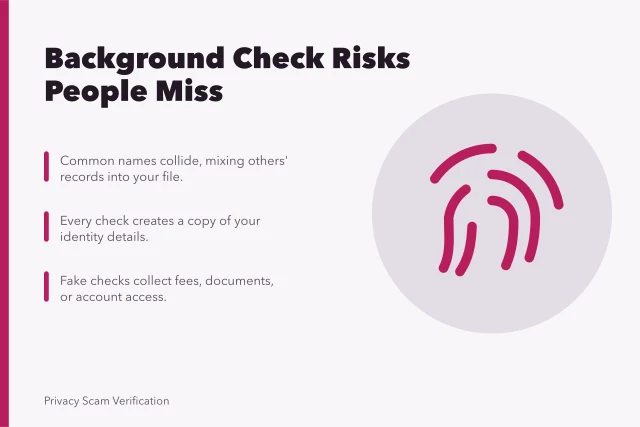
The changes worth catching are the ones you did not cause. An address you have never lived at. An account you did not open. A record belonging to somebody with a similar name. Each is ordinary rather than sinister, and each is easier to correct the year it appears than three years later when a decision depends on it.
Make it a calendar entry once a year, and again before any application that matters: a job, a tenancy, a loan. Use the official free route, not a service that markets to you. The legitimate one is described at the FTC's page on free credit reports.
The correction process, and who oversees it, is the Consumer Financial Protection Bureau's material on credit reporting.
What changes in the rules, and who sets them
This is the part where confident pages do the most damage.
Time limits on what may be reported and what categories may be considered vary by jurisdiction and get revised. So does the notice required before an adverse decision, and what a landlord or a volunteer scheme may ask. A page with a year in its title is a starting point, not a source.
Two concrete revisions. The federal Fair Credit Reporting Act generally drops most adverse items after seven years, and bankruptcies after ten. California's Fair Chance Act moved employer questions about criminal history to after a conditional job offer, and many states and cities keep their own ban-the-box dates.
The durable skill is knowing which body to ask. In the US, employment screening goes to the Equal Employment Opportunity Commission. Consumer reporting and disputes go to the Consumer Financial Protection Bureau and the Federal Trade Commission. State data protection authorities handle state privacy claims.
Outside the US, the national data protection authority or consumer regulator plays both roles. The four ideas that survive every revision, and the bodies to ask, are in background checks rules 2027.
What changes in the fraudulent version, and what does not
The surface changes constantly. This year it may be a job offer with no interview, a rental listed in photos only, or a recruiter who asks for a photo of your ID before any offer. The substance has not changed in years.
Scam surface vs substance
What gets updated
- Job titles
- Changes yearly
- Messaging app
- Moves around
- Verification name
- New branding
- Urgency reason
- Reworded
- Paperwork quality
- Improves
What stays the same
- Job titles
- Money requested
- Messaging app
- Documents before offer
- Verification name
- Sent link, not found
- Urgency reason
- Deadline pressure
- Paperwork quality
- Code, login, software
The unchanging column is short: a demand for money, a demand for documents, and a request for access to your accounts or devices. A process that asks for money or access is settled without knowing anything about this year's version, and the situations are laid out in background checks examples.
Red flags in practice: a job that asks you to pay for training, a landlord who wants a deposit before a viewing, a recruiter who sends a check to buy equipment, or anyone who asks for a one-time code.
Events that should trigger a check of your own
Rather than a schedule, some events genuinely justify looking.
Events that should trigger a check
- You were told a decision went against you because of a report.
- You moved, especially across a jurisdiction, since matching gets less reliable.
- Your documents were exposed in an incident or sent to somebody who turned out to be fake.
- Somebody with your name lives nearby or shares a date of birth.
- You are about to apply for something where a surprise would be expensive.
The document-exposure case needs its own handling rather than a look at the file. Report it at IdentityTheft.gov, which builds a recovery plan. Then place a free freeze or fraud alert with each of the three credit bureaus, Equifax, Experian and TransUnion.
If a Social Security number was exposed, request an IRS Identity Protection PIN and tell the Internal Revenue Service and the Social Security Administration. Keep the report number. The steps are set out at IdentityTheft.gov.
Three things that have not changed and probably will not
Three things have been true through every revision, and planning around them beats tracking anything.
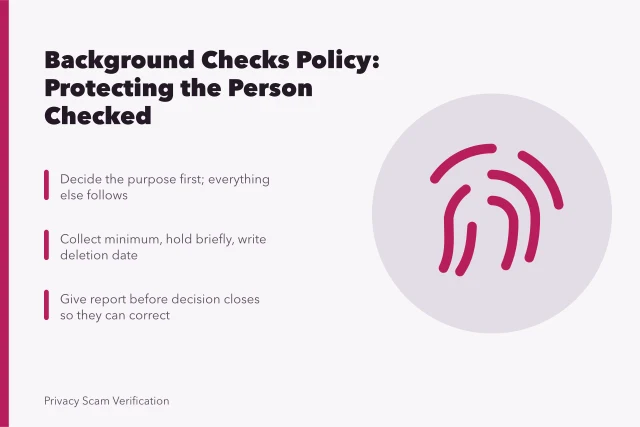
(1) You may see the file a decision-maker used. (2) You may dispute an error and get a correction. (3) A decision-maker must tell you before acting on a report against you.
Three rules that never change
- Employer requiring check pays for it
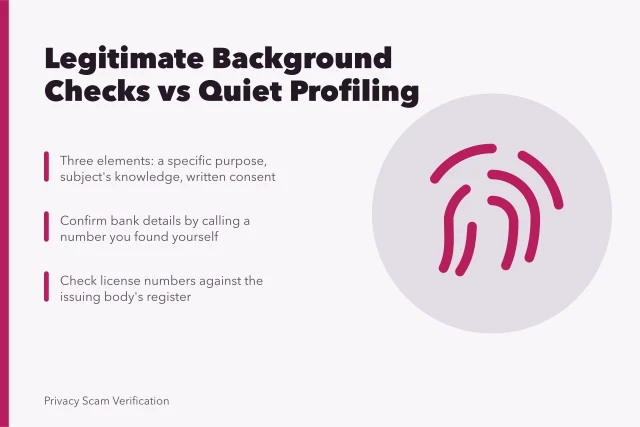
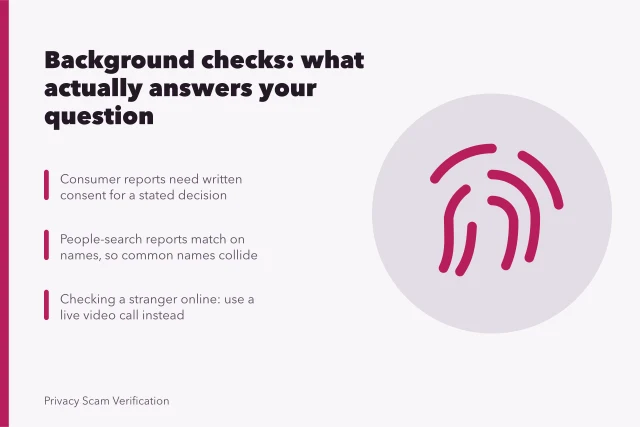
- Written consent for a stated purpose
- No password, code, or remote access
Those three are the load-bearing part of everything on this page.
Keeping your own view current without a subscription
You can do most of what a monitoring service does, for nothing, with three habits.
Read your file once a year, on a date you choose rather than when prompted. Turn on the alerts already available on accounts you own, so a change is a notification rather than a discovery.
Keep a short record of what you sent, to whom, and when. That record only pays off later, when somebody asks you to prove what happened.
Paid monitoring adds alerts when a new entry lands in your file at one bureau, and sometimes monitoring of court and criminal records. It does not add removal of accurate records, a copy of what a landlord or an employer sees, or any right you do not already have.
The tools are compared in best background checks tools 2027.
Common questions
How often do the rules actually change?
Often enough that any fixed number or date you read is worth checking against the regulator before you act on it. New state laws take effect on their own schedules, and federal limits rarely move.
My report has an error I have already disputed once. It came back. Why?
Data is copied between compilers, so a corrected entry can be reintroduced from another source. Dispute it again, in writing, and keep the earlier reference number, since a repeat correction is treated differently from a first one.
Is there any way to be told when someone runs a check on me?
Not reliably. Where a report is used against you, you are generally supposed to be told, which is the window that matters. Anything else is monitoring rather than notification.
Do old records ever disappear on their own?
Some age out according to local rules, and others persist because they sit in a different system. Do not assume, and do not pay anyone who promises removal.
What is the smallest useful habit here?
One calendar reminder a year to read your own file. It catches errors while they are cheap and it costs nothing, which is more than most of this market can say.