Costs
Part of Background checks with the guesswork removed (2027 update)
6 details of background checks risks people miss
Background check risk runs both ways: what a report gets wrong about you, what a check hands to a third party, and what a fake check is really collecting.
Two different things get called a background check risk, and they need separating before either can be managed.
One is the risk that a real check produces a wrong or unfair result about you. The other is the risk that submitting to a check hands your details to somebody who should not have them, including somebody who invented the check. They have almost nothing in common except the form you fill in.
What to take away
- Accuracy risk is managed by seeing the report, which means asking before a decision is final rather than after.
- Every check creates a copy of your identity details somewhere, and copies do not expire.
- A fake check is not trying to learn about you. It is collecting documents, money, or access.
The accuracy risk
Reports are assembled by matching records to a name, a date of birth, and an address history. That process fails in predictable ways.
Common names collide, so activity belonging to somebody else appears in your file. Old information persists past the point where it means anything. Records get attached to the wrong person entirely, particularly across jurisdictions where identifiers differ. And a report can be technically accurate while giving a misleading impression, because it lists an event without any of the context that explains it.
None of that is unusual, and the response is procedural rather than emotional. Ask for the report before the decision is final, dispute the specific entries in writing with the company that produced it, and keep the reference. The correction route and the bodies that oversee it are set out in background checks rules 2027.
The exposure risk
Every check you agree to creates a copy of your identity details in a system you will never see.
That copy is not usually the problem. The problem is the aggregate: over a working life you produce dozens, held by companies with different security, different retention, and different partners. Any one of them can be breached, and none of them will tell you they used your details for anything else. You cannot audit this and you should not pretend to.
What you can do is limit the additions that are optional. Do not send documents to organizations that have not made you an offer. Do not agree to checks for roles that do not exist yet. Do not use a third-party verification service somebody sends you a link to. Where documents have already gone somewhere they should not have, the monitoring steps are in identity verification.
The fake check risk
This is the one that costs money, and it is a different animal.
Fake check red flags
What is asked for
- Fee for your own screening
- Payment request
- Documents before any offer
- Identity collection
- Bank login to confirm income
- Account access
- Verification code from your phone
- Account takeover in progress
- Software installed to help
- Remote access
What it actually is
- Fee for your own screening
- Fee plus follow-up
- Documents before any offer
- Long-lived, documents do not expire
- Bank login to confirm income
- Immediate and severe
- Verification code from your phone
- The account and whatever it recovers
- Software installed to help
- Everything typed on that device
Cost if you comply
- Fee for your own screening
- Documents before any offer
- Bank login to confirm income
- Verification code from your phone
- Software installed to help
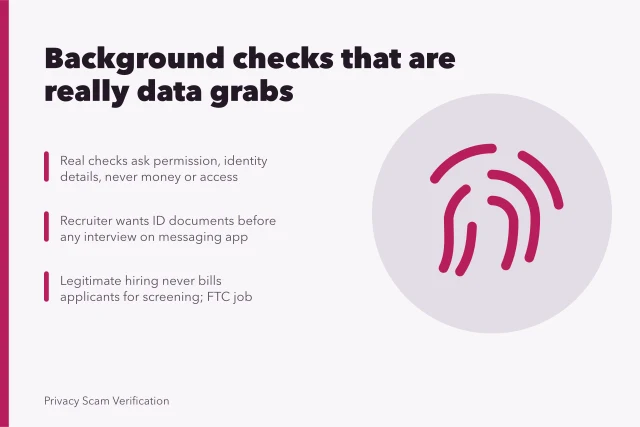
A fabricated check has a purpose, and the purpose is one of three things: to make you pay a fee, to collect identity documents worth using elsewhere, or to obtain access to an account of yours. Everything else about it is decoration to make those three requests look procedural.
What it actually is
- A fee for your own screening
- A payment request in a form
- Documents before any offer exists
- Identity collection
- A bank login to confirm income
- Account access
- A verification code from your phone
- An account takeover in progress
- Software installed so somebody can help
- Remote access
Cost if you comply
- A fee for your own screening
- The fee, plus a follow-up approach later
- Documents before any offer exists
- Long-lived, since documents do not expire
- A bank login to confirm income
- Immediate and severe
- A verification code from your phone
- The account, and whatever it recovers
- Software installed so somebody can help
- Everything typed on that device afterwards
The top two rows are the common ones. The bottom three are rare and serious, and they move the situation out of hiring entirely and into account security risks.
The risk of checking somebody else
Worth naming, because the instinct to run a check on a person you are dealing with is understandable and mostly unhelpful.
A paid people-search report about a name you were given cannot tell you that the person messaging you is that person. It answers a question you did not have. It also adds your own search and details into another system, and it can produce false confidence, which is worse than no information at all. The verification that works on a stranger is presence rather than paperwork, and that argument is made in catfishing.
What to watch for afterwards
Where a check has gone wrong in either direction, the aftermath is quiet rather than dramatic.
Watch for accounts or applications made in your name rather than for changes to accounts you already have, since collected documents are used to open things rather than to break into things. Expect a second approach that references the first, because a person who engaged once is worth approaching again. Treat any offer to fix, remove, or clear a record for a fee as part of the incident. Nobody legitimate approaches you first with an offer to repair your file.
Where money moved, the payment provider comes before anything else and the order is in reporting and recovery. The free route to your own consumer file, which is where errors surface first, is explained at the FTC's page on free credit reports, and the reporting company's obligations are described by the Consumer Financial Protection Bureau.
Sizing your own exposure
Four questions settle most of it.
Have I sent identity documents to anybody who did not have a decision to make about me? Has any check been run recently that I have not seen the result of? Is there anything in my file I would want to correct before somebody else reads it? And did I ever pay to be checked, which is both a loss and a marker that my details are on a list.
Honest answers here are more useful than any monitoring product, and they are free.
Common questions
Can I stop companies holding reports about me?
Not entirely. You can see what is held, correct what is wrong, and avoid adding to it unnecessarily. Anyone offering to erase your file is selling something that does not exist.
How often should I look at my own report?
Once a year is a reasonable habit, and again before any application that matters. Checking after a problem is the expensive version.
I paid a fee for a background check that turned out to be fake. Is the money recoverable?
Sometimes, and it depends on the payment method and how quickly you contacted the provider. Call them, and be prepared for the answer that it is not.
Does a clean report mean I am not at risk?
No. A report describes records, not exposure. The exposure is who holds copies of your details, and that number only goes up.
Should I use a service that monitors my background report?
Only after you have read the report yourself and understood what it contains. Monitoring a document you have never seen is paying somebody to watch a file on your behalf without knowing what is in it.