Rules
Part of Verifying a catfishing suspicion before you meet anyone in person
Catfishing detection tools: a guide to the criteria
Catfishing tools sorted into what proves presence, what proves reuse, and what proves nothing at all, with the paid category that targets people mid-incident.
What to take away
- No consumer product confirms who is typing. An unscheduled live video call comes closest, and it is free.
- Reverse image search across three photographs, not one, is the cheapest useful check available.
- Free tools match paid ones on reuse and presence. Paid tools mostly sell records attached to a name you supplied.
- Anyone who contacts you during or after an incident offering to trace a payment or recover money is a second loss.
- Run the ten-minute list below. Its last item beats every tool named here.
The three buckets
Every check fits one of three buckets. Which bucket you are in is most of the skill, and sellers blur the three on purpose.
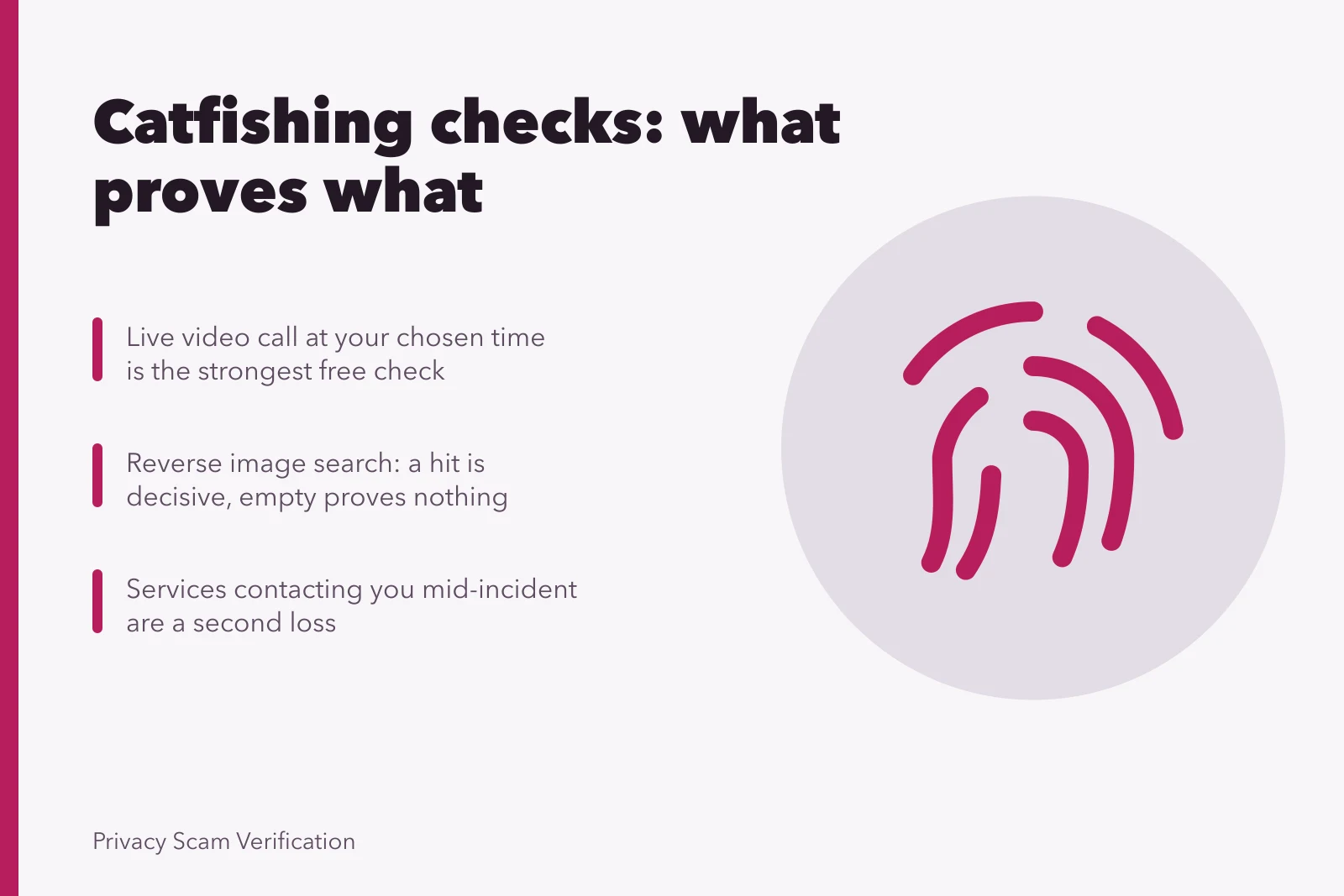
Reuse. Has this photograph or story appeared somewhere else? Google Lens, TinEye, Yandex Images and Bing Visual Search all answer that, and all are free. Instagram's "About this account" page shows a profile's country, join date and former usernames.
Presence. Is a responsive person there right now? Only a live video call, arranged at short notice and at a time you choose, answers it. A recorded clip does not answer it, and neither does a voice note.
Identity. Is this person who they claim to be? Nothing available to a private individual answers that, including a passport photo, a background report or a verification badge. A working brief on identity verification explains why the category stops short.
Cost
- Reverse image search
- Free
- Instagram "About this account"
- Free
- Live video call, unannounced
- Free
- People-search report
- Paid
- Recovery or tracing service
- Paid
What it can prove
- Reverse image search
- A photo is reused elsewhere
- Instagram "About this account"
- Join date, country, old usernames
- Live video call, unannounced
- A person exists and will appear
- People-search report
- A name has records attached
- Recovery or tracing service
- Nothing
An empty result means the search found nothing. It is not the same as there being nothing to find.
The bar a paid tool has to clear
Four conditions. Fail one and you close the tab.
- It states where its data comes from and how current it is.
- It writes down what a negative result means, without implying the person is genuine.
- It does not ask for your ID, your contacts or your documents to run a single check.
- It prices per check, so you can stop after the first one.
What a Paid Tool Must Do
- Reach a source you cannot reach yourself
- State what a clean result does not mean
- Work without collecting more about you
- Produce something you can act on
Reverse image search is free, and so is a video call. A paid product has to add something those two cannot. Almost nothing sold to consumers manages that, and the test is the same one that applies to phishing scam detection tools, where a warning is not a block.
What fails the bar, by name
- "AI catfish detector" apps that score a profile from its wording.
- People-search subscriptions from BeenVerified, Spokeo, TruthFinder and Intelius. These typically bill in a range of about 20 to 40 US dollars a month, taken before you see a result. The FTC's guide to protecting your privacy online covers how to get your own details out of those databases afterwards.
- Dating app photo verification used as proof of identity. It records that a face matched a pose at one sign-up, which says nothing about who is typing tonight.
- Tracing and recovery services, dealt with below.
Where the money goes wrong
The market aimed at people mid-incident is the one to name plainly. Services promising to identify whoever is behind an account, trace a payment or recover money charge a fee first. They are overwhelmingly a second loss.
The shape rarely varies. Contact comes first, then a fee before any result, then vague findings, then continuing charges.
A live video call costs you a minute. A recovery service costs a fee before any result, and often a monthly charge after it.
The routes that work are free. Your payment provider, the platform's own reporting process, and your national fraud body. In the US, consumer fraud reports go through the Federal Trade Commission's report route. The order for the rest is set out in which comes first after a scam.
Example: one search, two endings
A reader searches three profile photographs. One matches a stock photo listing under a different name. That is a hit, and a hit is an ending. Block, screenshot, keep the evidence, and say nothing, because a confronted operator rewrites the story.
A second reader finds no match anywhere. The photographs may still be lifted from a private album, a locked account or a deleted post, so the search has proven nothing about the person.
That returns you to the question that decides your next move. Does this situation require you to send money, documents or images to somebody you have not met? If it does, the answer is no.
The checks worth doing in ten minutes
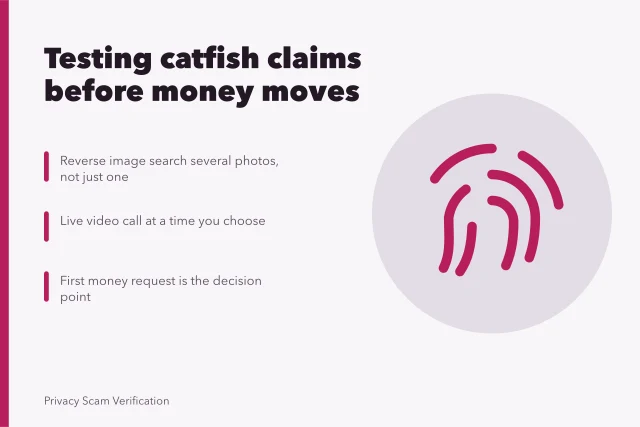
- Run the profile photo through Google Lens, TinEye and Yandex Images. Use three photographs, not one.
- Search a distinctive sentence from the profile, in quotation marks.
- Open "About this account" on Instagram for the join date, country and old usernames.
- Match the first name against the storysame job, same city, same dead spouse.
- Ask for a live video call tonight, at a time you name. Watch when the excuses start.
Checks Worth Doing in Ten Minutes
- Run several photographs through reverse image search
- Ask for a video call this evening
- Search a distinctive profile phrase in quotes
- Ask an ordinary specific question about location
- Tell one person in your life
The last item outperforms every tool here, because these situations work by keeping the target alone with the problem. Six things worth knowing about romance scams risks covers how the approach is built over weeks, and the Wikipedia entry on romance scams records the same pattern.