Reviews
Part of Which comes first after a scam: reporting it, or preserving evidence?
Scam reporting and recovery tools: ranked by what they actually do
Scam reporting and recovery tools ranked by what each can do, from the bank call that stops money to the paid services that take a second payment.
What to take away
Scam reporting and recovery tools rank by what they can actually do. A free call to your bank or card issuer sits at the top. Everything else is ranked against it. Paid recovery services that call you first sit at the bottom.
- Your bank or card issuer is the only party that can attempt a recall. Its window is measured in hours, not weeks.
- The FTC, the FBI's IC3, the Canadian Anti-Fraud Centre and your local police all take reports. None recovers money for you.
- Identity monitoring from Equifax, TransUnion, Aura and LifeLock shortens how long a fraudulent account stays invisible. None prevents fraud or removes your data.
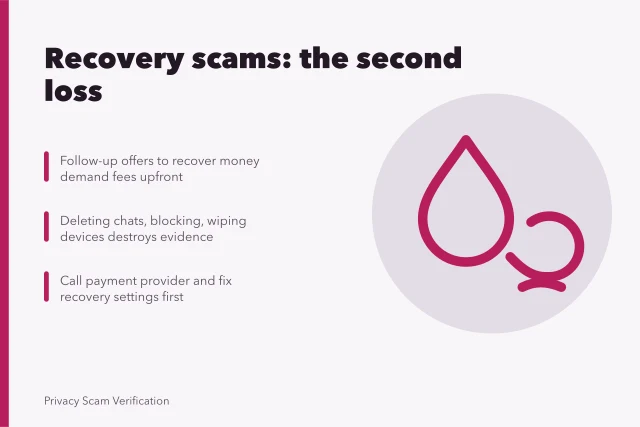
- Recovery services that contact you first are part of the incident.
- Your own evidence folder makes every other route work. It is the one part you fully control.
Ranked: 10 scam reporting and recovery tools by what they do
The list names real routes and real products. It ranks money-moving and account-freezing routes first. It puts fee-first services last. Costs are typical US or Canadian figures unless noted. The table covers the United States and Canada only, and the equivalents elsewhere are named further down.
| Rank | Tool | What it does | What it cannot do | Cost |
|---|---|---|---|---|
| 1 | Your bank or card issuer (for example Chase, Bank of America, RBC, TD) | Attempts a recall, opens a dispute, blocks the card | Reverse a wire or crypto transfer | Free ($0) |
| 2 | Interac e-Transfer recall (Canadian banks: RBC, TD, Scotiabank, BMO) | Cancels an unclaimed transfer or flags a claimed one | Recover money the recipient already withdrew | Free ($0) |
| 3 | Platform report (Facebook Marketplace, Kijiji, eBay) | Acts on the account, preserves records, refunds inside buyer protection | Return money that moved off the platform | Free ($0) |
| 4 | FTC ReportFraud, FBI IC3, Canadian Anti-Fraud Centre | Records the case, feeds pattern data, issues a reference number | Investigate your case individually | Free ($0) |
| 5 | Local police | Acts where there was a meeting, a threat, or a local account | Pursue someone abroad over a small sum | Free ($0) |
| 6 | Equifax and TransUnion | Credit report, fraud alert, credit freeze, dispute | Prevent a new account being opened under your name | Free reports from AnnualCreditReport.com; monitoring typically $10 to $30 a month |
| 7 | Aura, LifeLock, IdentityGuard | Dark-web and account monitoring, some restoration help | Remove your data or tell you who holds it | Typically $10 to $35 a month |
| 8 | Data-broker removal (DeleteMe, Kanary) | Files opt-out requests under state statutes | Delete everything, or stop resale | Typically $100 to $250 a year per person |
| 9 | A lawyer or licensed adviser you hired | Handles a large loss or a dispute with an institution | Work for free, or guarantee an outcome | Typically $150 to $500 an hour in the US, or a flat fee quoted in advance |
| 10 | A recovery service that contacted you (the advance-fee recovery room, a tracing firm that asks for payment in crypto) | Takes a fee | Almost anything else, and it cannot be verified through a body you found yourself | Upfront fee, often several hundred dollars, then more requests |
Row ten is not a joke. It is the finding.
Two patterns cover most of these operations. The advance-fee recovery room asks for a release fee, a tax, or a clearance charge before anything is returned. The tracing firm asks for payment in crypto, or for a wallet connection, before it traces anything. Both are complaint patterns rather than one company.
Typical reported losses sit in the hundreds of dollars for ordinary consumer fraud and in five figures for investment and romance cases. No agency publishes a recovery rate that applies to your case, because reported figures cover only the cases that were reported. What decides recovery is the payment method and the hours right after the transfer.
That is why the ranking puts money-moving routes first.
The order that gets the most out of them
Sequence matters more than which body you pick. Two routes expire: the recall window at your bank or card issuer, and the unclaimed-transfer window at Interac.
Order that gets most back
- Call provider first, window narrows hourly
- Save evidence second, before deletion
- Report inside platform third, before blocking
- File official report fourth, keep reference number
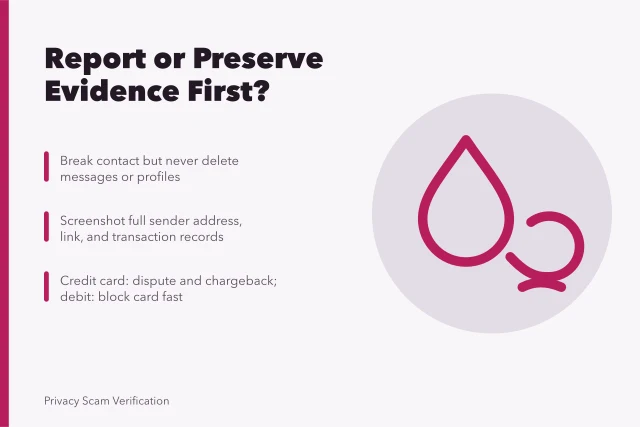
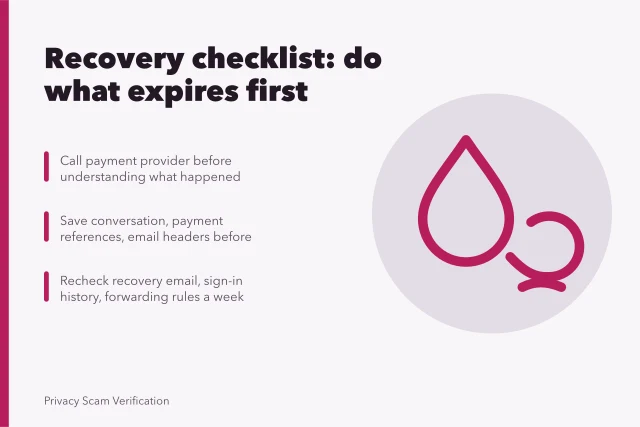
- Call the payment provider first. Bank, card issuer, or Interac. This step has a window measured in hours.
- Ask for that specific transaction to be stopped, recalled, or disputed, and take a reference number.
- Preserve the record. Screenshots of the messages, the profile, the listing, the payment reference, the amount and the date go into one folder.
- Report to the platform where the contact started. Ask it to act on the account and to preserve its own records.
- File with the FTC and the IC3 in the US, or the Canadian Anti-Fraud Centre in Canada. Keep the reference number.
- Place a fraud alert or a credit freeze if identity details were shared. Dispute anything that appears.
- Escalate in writing if the provider refuses. A written refusal is what a regulator or ombudsman works from.
That order, with account and identity work folded in, is set out step by step in reporting and recovery checklist.
The official routes: FTC, IC3, Canadian Anti-Fraud Centre, and privacy commissioners
In the US, consumer fraud reports go through the Federal Trade Commission's report route. That page also carries advice on what to do after a scam.
Internet-enabled crime goes to the FBI's Internet Crime Complaint Center. It explains plainly what a complaint is used for and what it is not.
In Canada, the Canadian Anti-Fraud Centre takes the report and feeds the pattern data. The Office of the Privacy Commissioner handles the data side. Identity misuse has its own guided recovery process, which produces a plan and the letters that go with it.
Outside North America, the shape holds even when the names change. Look for a national fraud reporting service, a financial regulator or ombudsman for disputes with providers, and a data protection authority.
In the UK those three are Action Fraud for the report, the Financial Conduct Authority or the Financial Ombudsman Service for a dispute with a provider, and the Information Commissioner's Office for a data complaint. Finding those three for where you live beats any product on the market.
The paid market: Aura, LifeLock, IdentityGuard, DeleteMe, Kanary, and lawyers
Three categories, and only one is sometimes worth money.
Recovery and tracing services. They approach you, charge upfront, produce vague progress, and keep charging. Treat any unsolicited offer as part of the incident rather than a response to it. The reasoning behind that, and why the approach is so well informed, is in reporting and recovery risks.
Identity monitoring and removal. Aura, LifeLock and IdentityGuard sell monitoring. DeleteMe and Kanary sell opt-out filing under state data-broker statutes. Legitimate products, oversold as solutions. They shorten the gap between something appearing and you knowing. They cannot prevent, remove permanently, or name who holds your details.
Licensed professionals you approached. A lawyer or licensed adviser, in your jurisdiction, engaged by you at an agreed rate, for a specific question such as a large loss or a dispute with an institution. This is the category that can be worth it.
Judging any offer of help in one minute
Four questions, and the first is usually enough.
Judging any offer of help
- Who made contact first? If they approached you, the other three rarely matter.
- What is the fee, and when is it due? An upfront fee, or one that keeps growing, ends the conversation.
- Which regulator or licensing body can I check you against? If you cannot find one yourself, stop.
- What exactly is promised? A named, dated, checkable outcome, or a vague assurance of recovery.
Judging any offer of help
Did they contact me, or did I go to them?
treat as part of the incident
continue checking the offer
An offer that fails the first two fails all four in practice. The direction of contact carries more information than the content of the message. The general form of that is in phishing scams.
The tool people forget they have
Your own record.
A folder holds the conversation, the payment references, the account names, the dates, and every reference number. It makes each official route work, and it is the only part of the process fully under your control.
The folder also turns a distressing memory into documents. It is easier to hand to a bank and easier to put down.
Where account access was involved rather than only money, the parallel work is in account security.
Common questions
Which single route should I use if I only do one thing?
The payment provider, immediately. It is the only one with a realistic chance of stopping the loss rather than recording it.
Do official reports ever lead to my money coming back?
Sometimes, usually indirectly. That is most likely where a payment was caught early or a domestic account was involved. Do it for the reference number and the aggregate value. Treat any personal recovery as a bonus.
Is a paid service ever the right answer after a scam?
A licensed professional you approached, for a defined question.
What if my bank refuses to help?
Ask for the decision in writing. Then escalate to the financial regulator or ombudsman where you live. Written refusals are the material for that process.