Industry
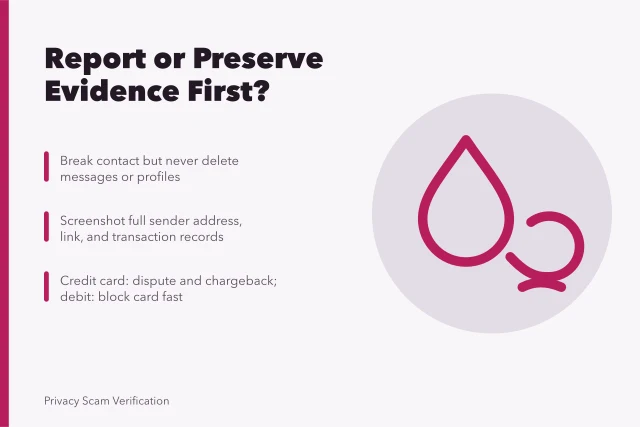
Part of Which comes first after a scam: reporting it, or preserving evidence?
Recovery brings its own risks, especially right after a scam
Recovery has its own risks: the second approach that targets people mid-loss, evidence destroyed by tidying up, and decisions made while you are exhausted.
The period after a scam has its own hazards, and several of them are worse than the original loss.
That sounds like an overstatement until you see what happens. People pay again to someone offering help, delete the only record, tell an organization something that closes their claim, and make a large decision while running on very little sleep.
None of that is carelessness; it is what being in the middle of it does.
What to take away
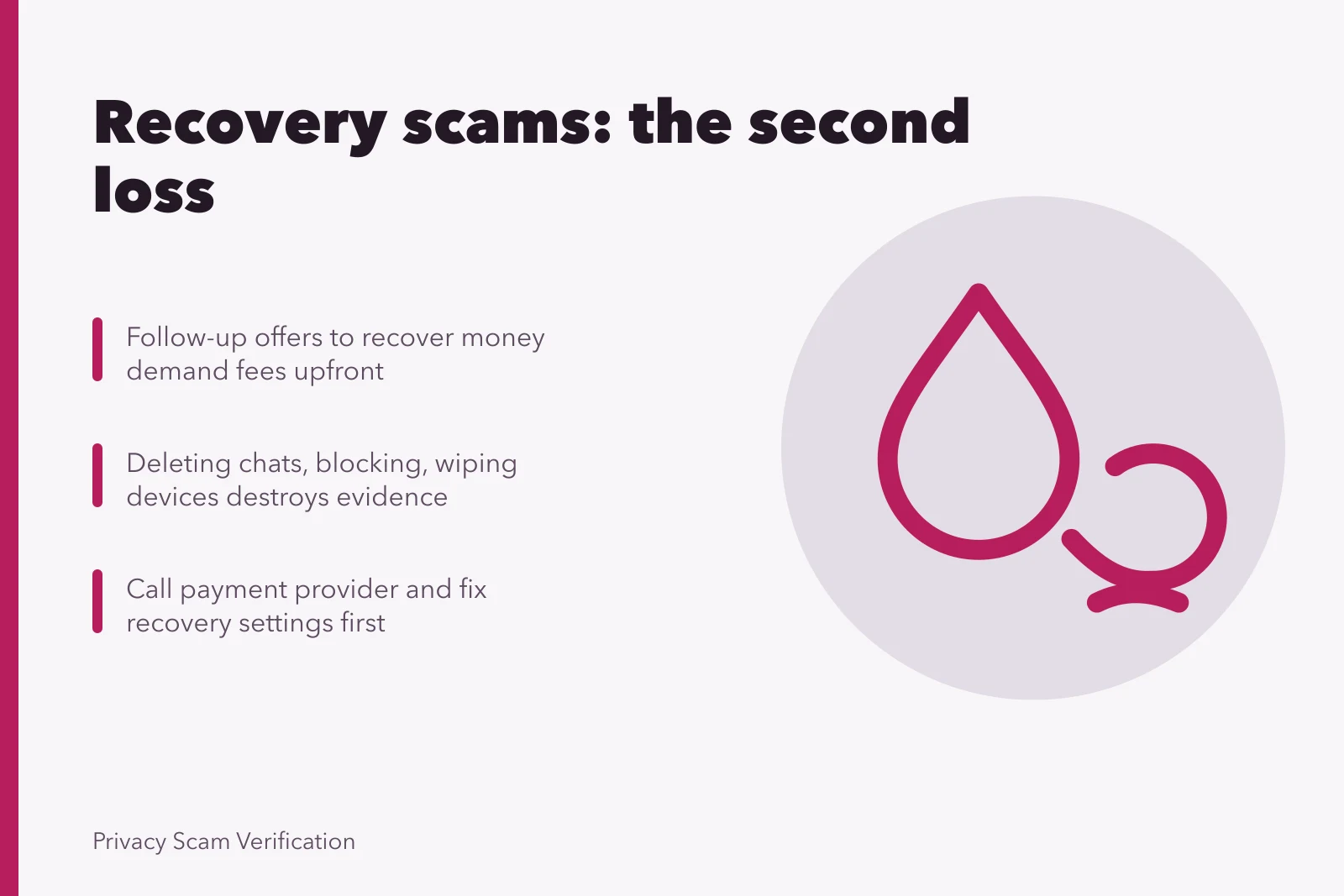
- The most reliable follow-up to a loss is an offer to fix it, and paying for that offer is the second loss.
- Tidying up destroys evidence, which is the one asset you still have.
- Decisions made in the first forty-eight hours are worse than decisions made in the first week, apart from the two that cannot wait.
The second approach
It is not a rumor and it is not rare. People who have lost money get contacted afterwards, sometimes within days, by individuals and businesses offering to recover it.
The approach is often specific. It may cite the amount, platform, or date, because details circulate. It may pose as an investigator, recovery agency, legal service, or a department of a body you have heard of.
It will ask for a fee before anything happens, for your identity documents to begin, or for access to an account to trace the payment.
Two sentences settle all of it: nobody legitimate contacts you first offering to recover money, and no agency charges you to investigate a crime committed against you. That holds regardless of how much they know about your case, and knowing details is evidence of information circulating rather than evidence of authority.
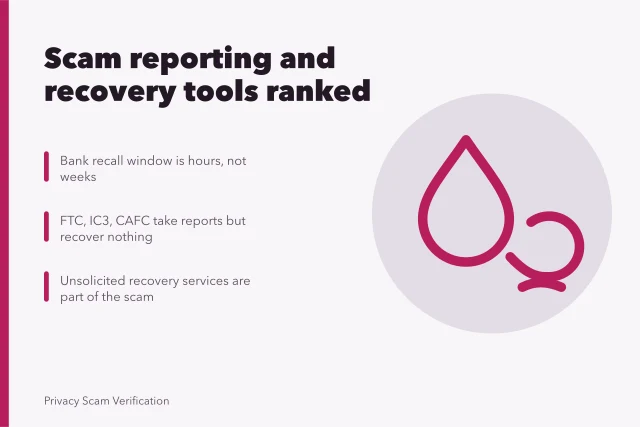
The same market and how it is sold are described in best reporting and recovery tools 2027.
The evidence risk
Almost everybody's instinct after a loss is to make it go away, and every part of that instinct is wrong.
| What people do | What it costs |
|---|
What not to do after a loss
What people do
- Delete the conversation
- Record bank or platform needs
- Block before reporting
- Platform cannot see context
- Wipe or reinstall device
- Technical review evidence lost
- Close the account involved
- History and recovery route lost
- Throw away packaging or listing
- Proof of what was sent
What it costs
- Delete the conversation
- Block before reporting
- Wipe or reinstall device
- Close the account involved
- Throw away packaging or listing
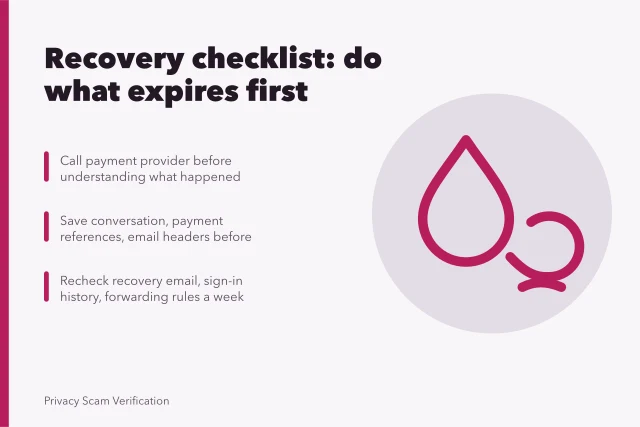
Save first, in one folder, then clean up. The order and the specific items are in reporting and recovery checklist.
The decisions worth delaying
Two things cannot wait: the call to the payment provider and the recovery settings on any account involved. Almost everything else can, and should.
What can wait, what cannot
Can it wait until you are rested?
delay closing, moving, signing, concluding
call payment provider, check recovery settings
Delay closing accounts, moving money to new institutions, and any public statement beyond a short warning to people who might be approached.
Delay signing anything, including anything a bank or platform asks you to sign to settle a claim, until you have read it when rested. Delay conclusions about responsibility; they harden into statements organizations will hold you to.
The exception worth naming is telling somebody. That should not wait, and it is the one that makes every other decision better.
The risk of saying the wrong thing to the right people
Claims are decided partly on how the events are described, and people describe them badly while distressed.
How to describe the events
- State what happened factually, in order
- Do not editorialize about your own judgment
- Do not guess at details you do not remember
- Do not agree you authorized what deceived you
- Keep a written note of what you told whom
State what happened factually, in the order it happened, without editorializing about your own judgment. Do not guess at details you do not remember. A wrong guess is treated as an inconsistency later.
Do not agree that you authorized something because a screen said you did, when the honest answer is that you were deceived into approving it. Keep your own written note of what you told each organization and when.
None of that is gaming a process. It is the difference between an account of events and a confession written under stress.
The slower risks
Repeat targeting. Being a name that responded once is durable, and the next approach will know more. Treat unexpected contact as a permanent feature rather than a sign that something new has gone wrong.
Risks that arrive late
- Repeat targetingexpect more contact
- Documents in circulationwatch for things opened in your name
- Account access held quietlyrecheck recovery settings
- Shamethe mechanism that stops people asking for help
Documents in circulation. Where identity material was exposed, the effect arrives late, in the form of things opened in your name rather than access to what you have, and the checks for it run through identity verification.
Account access held quietly. Whoever had access may not use it immediately. The recovery settings check a week later exists for that reason and it is the one people skip.
The cost that is not money. The shame is the mechanism the whole thing runs on, and it does the most damage in the weeks afterwards, when it stops people asking for help, reporting, or telling their bank the full story.
What honest recovery looks like
Some money comes back, usually where the payment method supported a dispute and the call was fast. Most does not. Accounts are usually recoverable with patience. Identity exposure is managed rather than fixed. Nobody is usually prosecuted, and that is a fact about jurisdiction and cost rather than about how seriously anybody takes it.
Reports still matter, for the reference number and for the aggregate picture, and the routes are set out at USAGov's page on where to report a scam. Where financial providers are involved, complaints have their own route through the Consumer Financial Protection Bureau. The full sequence is in reporting and recovery.
Common questions
Someone contacted me who knows exactly what happened. Does that prove they are real?
No. It proves information moves. Verify independently by contacting the body they claim to represent through details you find yourself, and expect to learn that nobody contacted you.
Is it worth paying a lawyer?
Possibly, for a large loss, a dispute with an institution, or a legal exposure of your own. Pay a licensed professional you approached, at a rate agreed in advance, and never somebody who approached you.
I deleted everything already. Is it hopeless?
No. Banks and platforms hold their own records, and you can still report. It is harder, not over.
How long before I stop feeling stupid?
Longer than it takes to fix the accounts, and it passes faster once one person knows. These situations are run by people who do this full time, and being caught says nothing about your intelligence.
When is the incident actually over?
When the money question is settled, the accounts are secure, the reports are filed, and the week-later checks are clean. The alertness stays, at a low level, and that is a reasonable end state rather than a failure.