Industry
Part of Impersonation runs both ways: protecting your name and your trust in others
Four free habits versus paid impersonation monitoring tools
Four free habits that block impersonation, measured against paid monitoring tools like BrandYourself, ZeroFox and Aura, and what each one can actually prove.
No monitoring product can tell you an account is genuine. It can only tell you a copy exists.
That asymmetry decides whether the subscription is worth anything. Detection returns positives or silence, never a clearance. A tool earns its fee only when it finds a copy you would have missed, and finds it first. The four free habits below close more than any of them do.
This comparison of four free habits versus paid impersonation monitoring tools names seven services: BrandYourself, ZeroFox, ReputationDefender, Aura, LifeLock, DeleteMe and Incogni. Some watch for fake profiles. The rest watch for leaked data.
What to take away
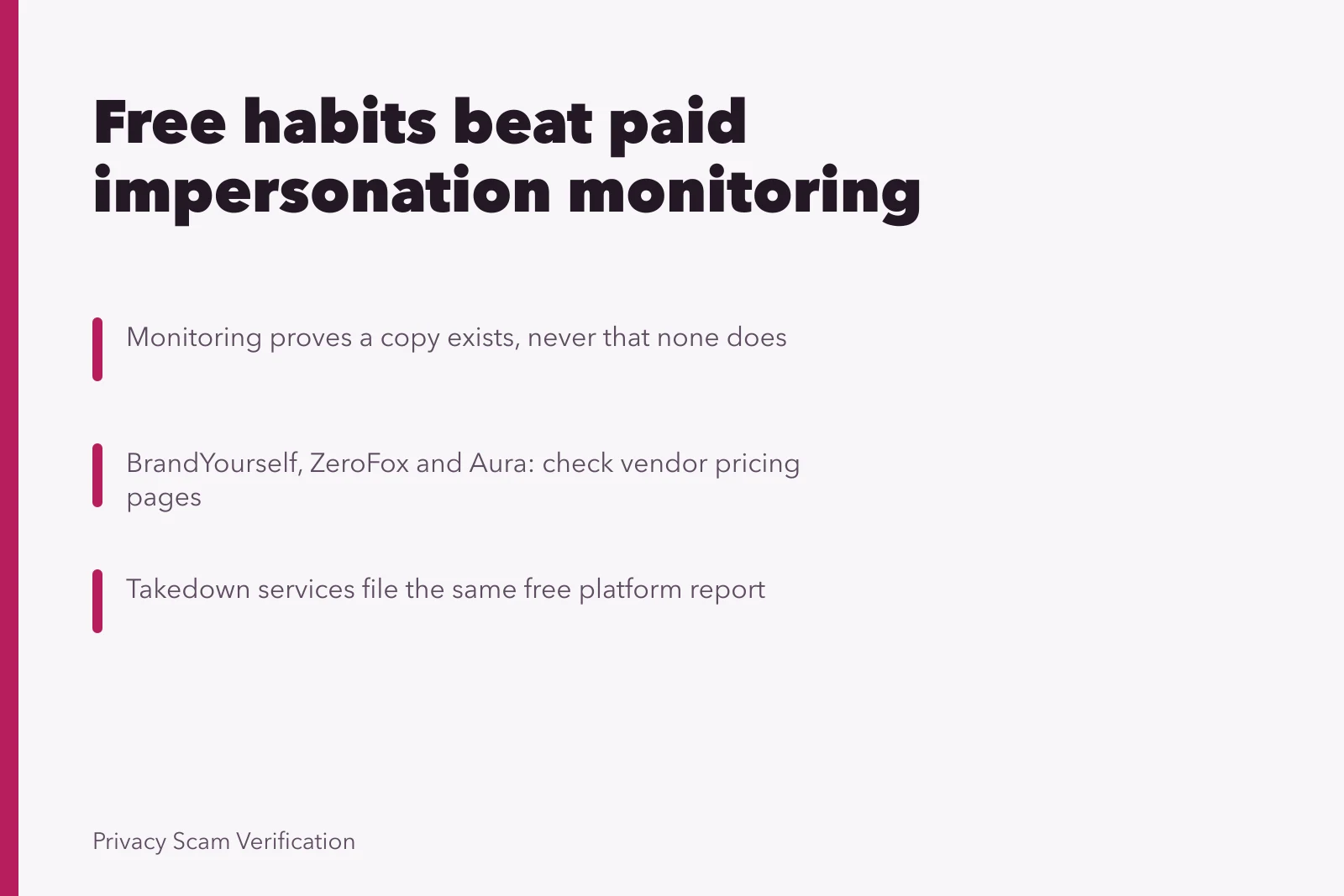
- Monitoring proves a copy exists. It can never prove that none does.
- The four habits that block copies are free and live in account settings, not in software.
- Paid tools split into two groups: brand and handle monitoring, and identity and breach monitoring. They answer different questions.
- Anything sold to you during an incident, especially takedown or reputation work, is usually the second loss.
- A takedown service files the same report you can file yourself, at no charge.
The four free habits
Each one removes something an impersonator needs. None costs money.
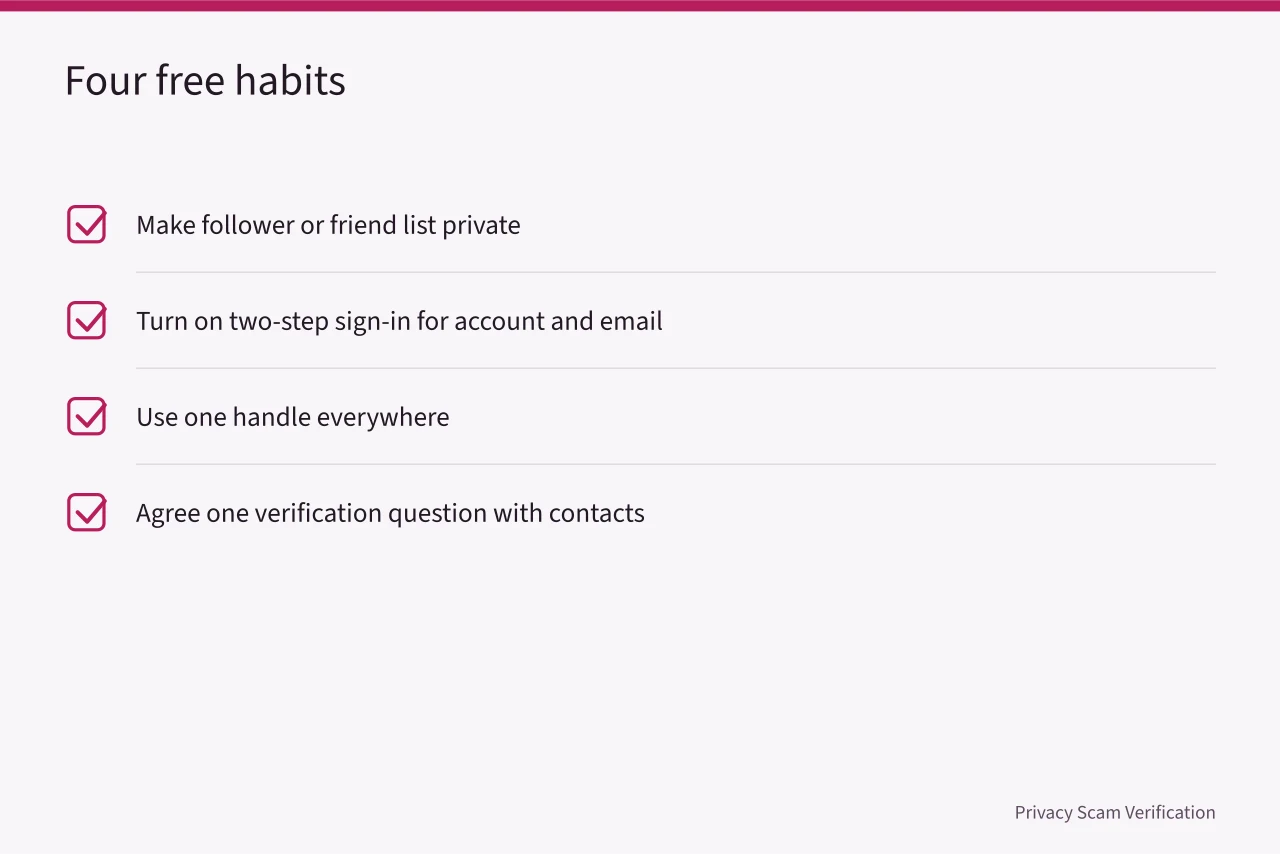
- Make your follower or friend list private. A copy borrows your audience to look credible. Hide the list and the copy has no one to borrow. Facebook calls the setting Only me. LinkedIn hides connections under visibility settings.
- Turn on two-step sign-in for the account and its email. A copy becomes a takeover when the attacker gets into the real account. The email matters as much as the profile.
- Use one handle everywhere. People checking whether a message is yours need something to compare against. A single handle across services gives them that without asking you.
- Agree one verification question with the people most likely to be approached in your name. A question only the real you can answer settles an urgent request in one line.
The mechanics of the second habit, and what to do when a code has already been shared, are in account security. The settings work sits in privacy settings.
The paid tools, by name: BrandYourself, ZeroFox, Aura, LifeLock, DeleteMe
These are real products with published terms. Prices change, so check the vendor page before buying.
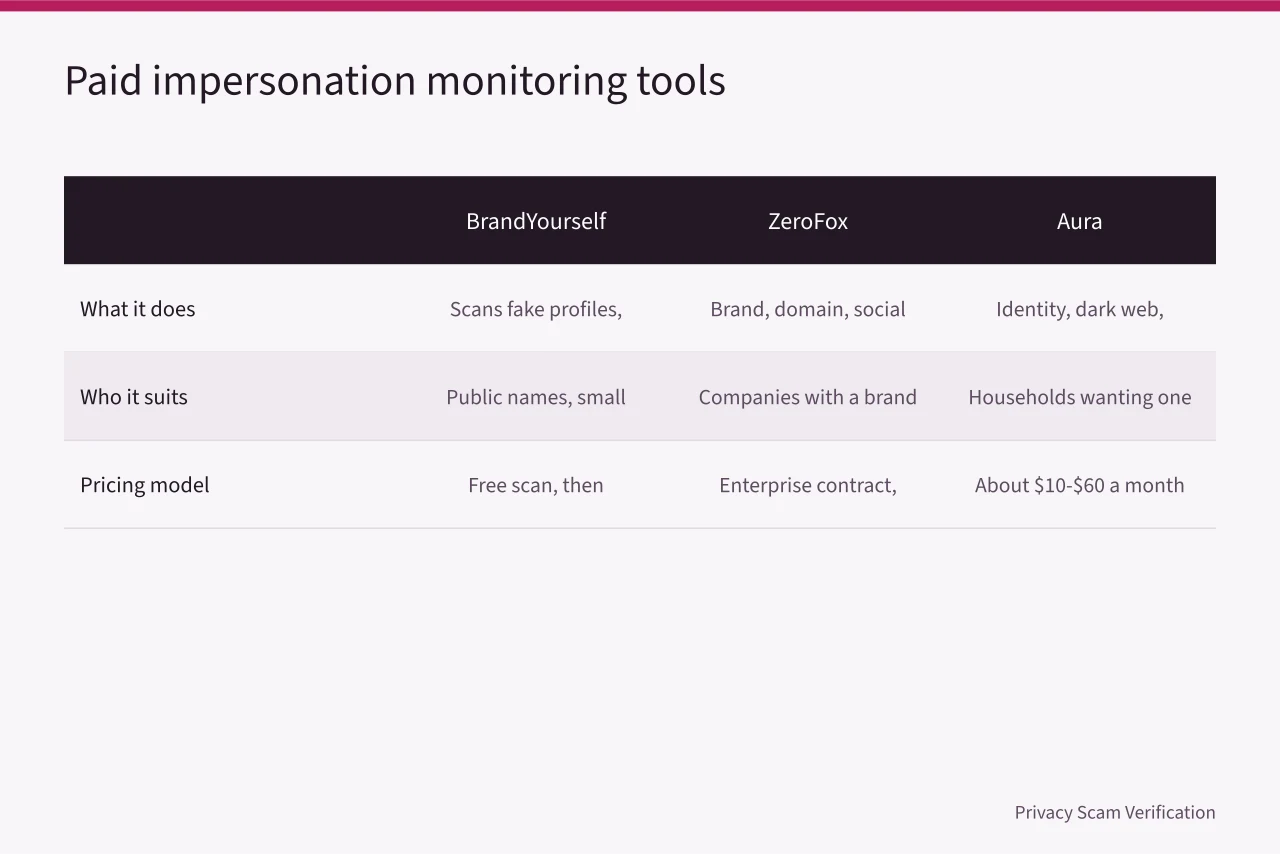
| Tool | What it does | Who it suits | Pricing model |
|---|---|---|---|
| BrandYourself | Scans for fake profiles and unauthorized use of your name, and files takedown requests on your behalf | Individuals and small businesses with a public name | Free scan, then roughly $100 to $500 a year, tiered by profiles watched |
| ZeroFox | Brand, domain and social media monitoring for organizations, with takedown workflow built in | Companies with a brand to defend | Enterprise contract, quoted; no public list price |
| ReputationDefender | Search result suppression, personal information removal and takedown requests | Executives and professionals whose name brings in work | Quoted annual engagement; no public list price |
| Aura | Identity monitoring, dark web alerts and some impersonation cover bundled with credit monitoring | Households wanting one subscription across several risks | Roughly $10 to $60 a month, by people covered and billing cycle |
| LifeLock | Identity and dark web monitoring, with restoration support after a confirmed theft | People who want a service to do the recovery work | Standard near $9 a month, Advantage near $18, Ultimate Plus near $35 |
| DeleteMe | Removes your data from data broker sites and repeats the removal over time | People whose exposure is broker listings, not fake profiles | About $129 a year for one person; family plans cost less per head |
| Incogni | Sends and repeats data broker removal requests on a schedule | People who want cheap, hands-off broker removal | From about $8 a month billed annually, higher tiers for families |
Three of these answer "is someone pretending to be me". Four answer "is my data out there". Those are different questions, and a single subscription rarely covers both well.
ZeroFox and ReputationDefender sell to companies, so a household buyer sees no price until a sales call. The other five publish tiers.
What a tool would have to do to earn its price
Set the bar before you look at anything. It is a short list.
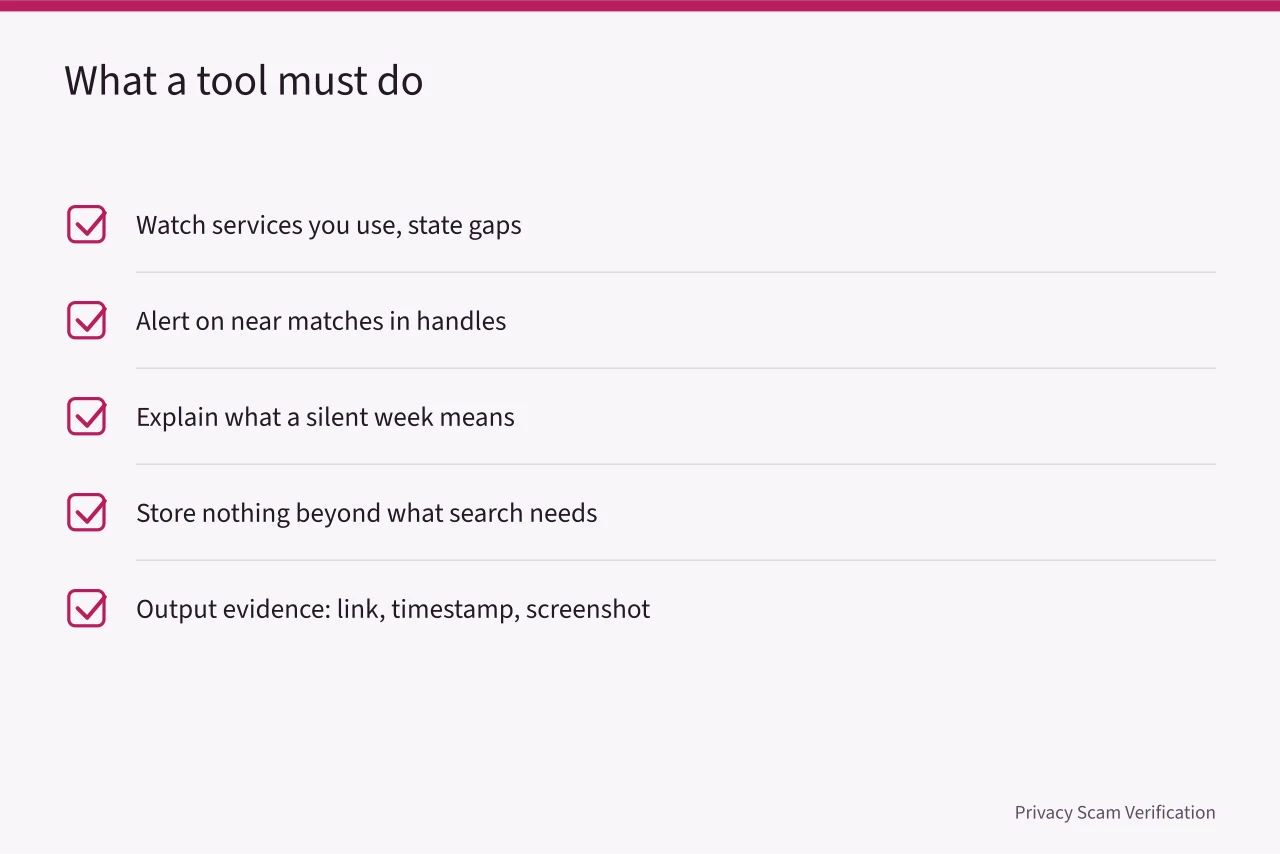
It would have to watch the services you actually use, and state plainly which ones it does not cover. It would have to alert on near matches, since almost every copy adds a character to the handle. It would have to explain what a silent week means, in those words.
It would have to store nothing beyond what the search needs. A monitoring service holding your documents has added an exposure to watch. Its output would have to be evidence you can file: a link, a timestamp, a screenshot.
Most marketed tools clear two of those five.
The category to be most careful with
There is a market aimed at people mid-incident.
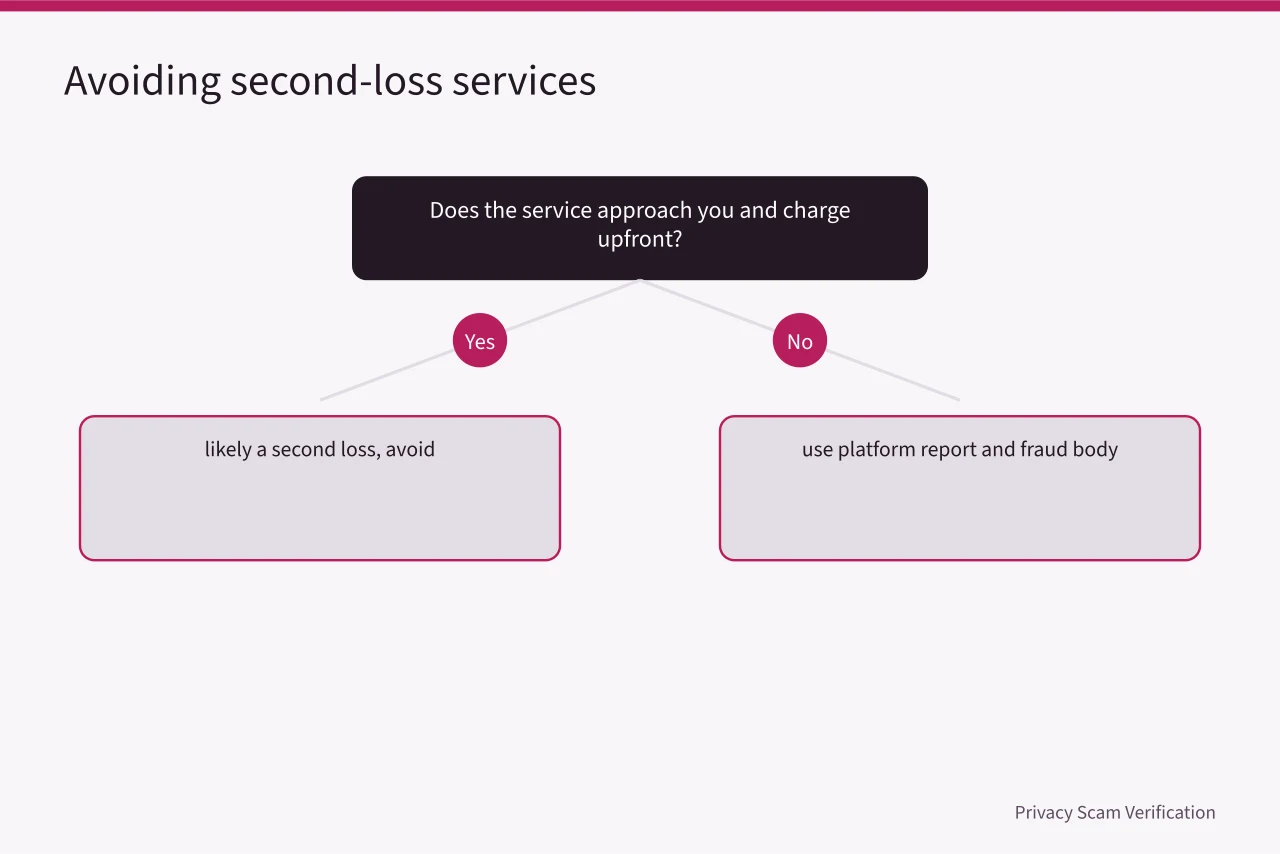
Services that contact you to remove a fake account, restore your name, unmask whoever is behind it, or investigate for a fee are usually the second loss. The pattern holds: they approach you, charge before anything happens, and keep charging while progress stays vague.
No genuine agency charges you to investigate a crime against you. No legitimate service takes an upfront fee to make an account disappear. Unpaid routes work: the platform's own impersonation report, filed by you and separately by those contacted, plus your local fraud reporting body.
In the US, use the Federal Trade Commission's consumer advice on avoiding scams. If an account was taken over rather than copied, follow the FTC guidance on recovering a hacked account.
Judging a tool you already pay for
Three questions, answerable in ten minutes.
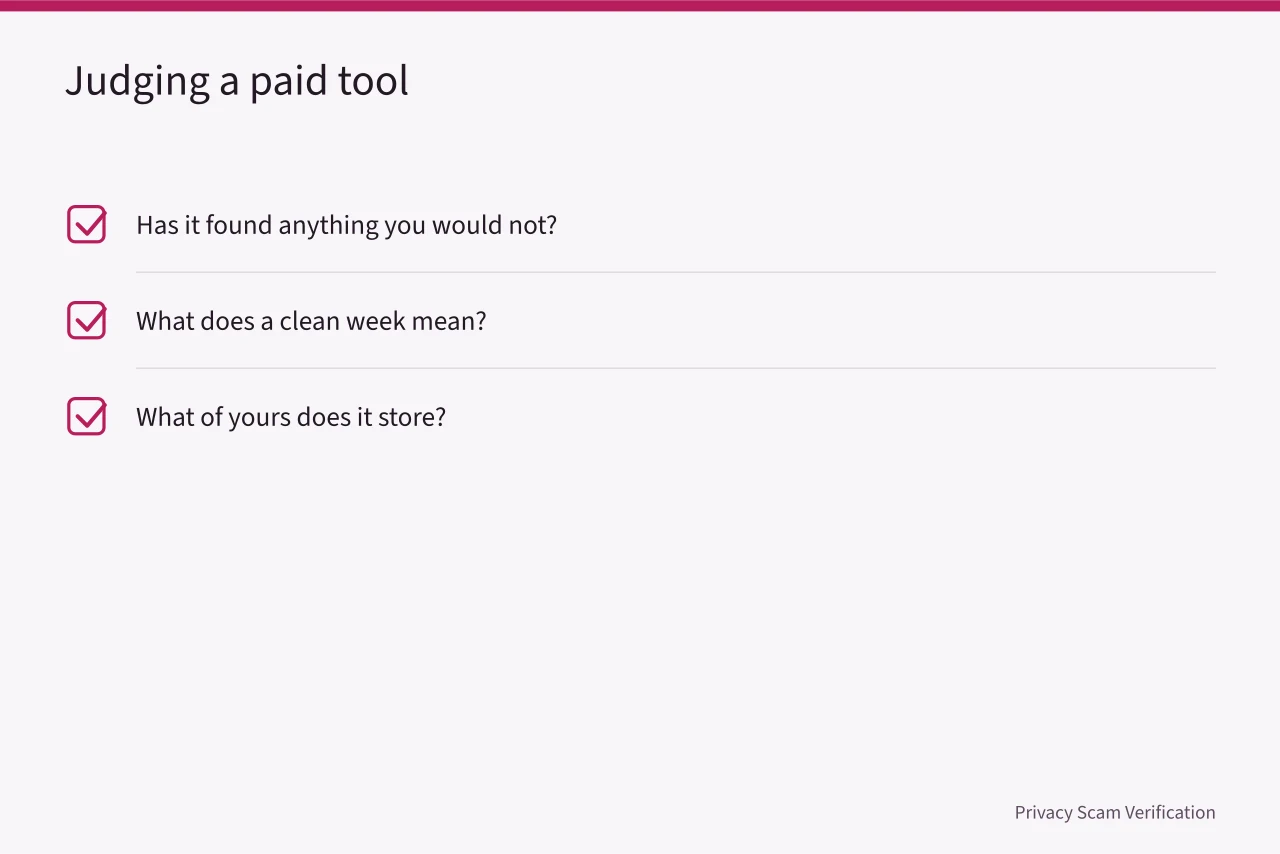
Has it found anything you would not have found, and did it find it before someone told you? What does it say a clean week means, and does that wording claim more than a search can support? What of yours does it store, and what happens to that if you cancel?
If the answers are nothing, an implied clearance, and more than you expected, you are paying for reassurance. That is a fair thing to buy, as long as you know that is the purchase. Where money has already moved, the order to work through is in reporting and recovery.
DeleteMe bills by the year only. Cancel before the renewal date, not after, if the three answers disappoint you.
Where monitoring genuinely pays
It is not useless. The cases where it earns its place are specific.
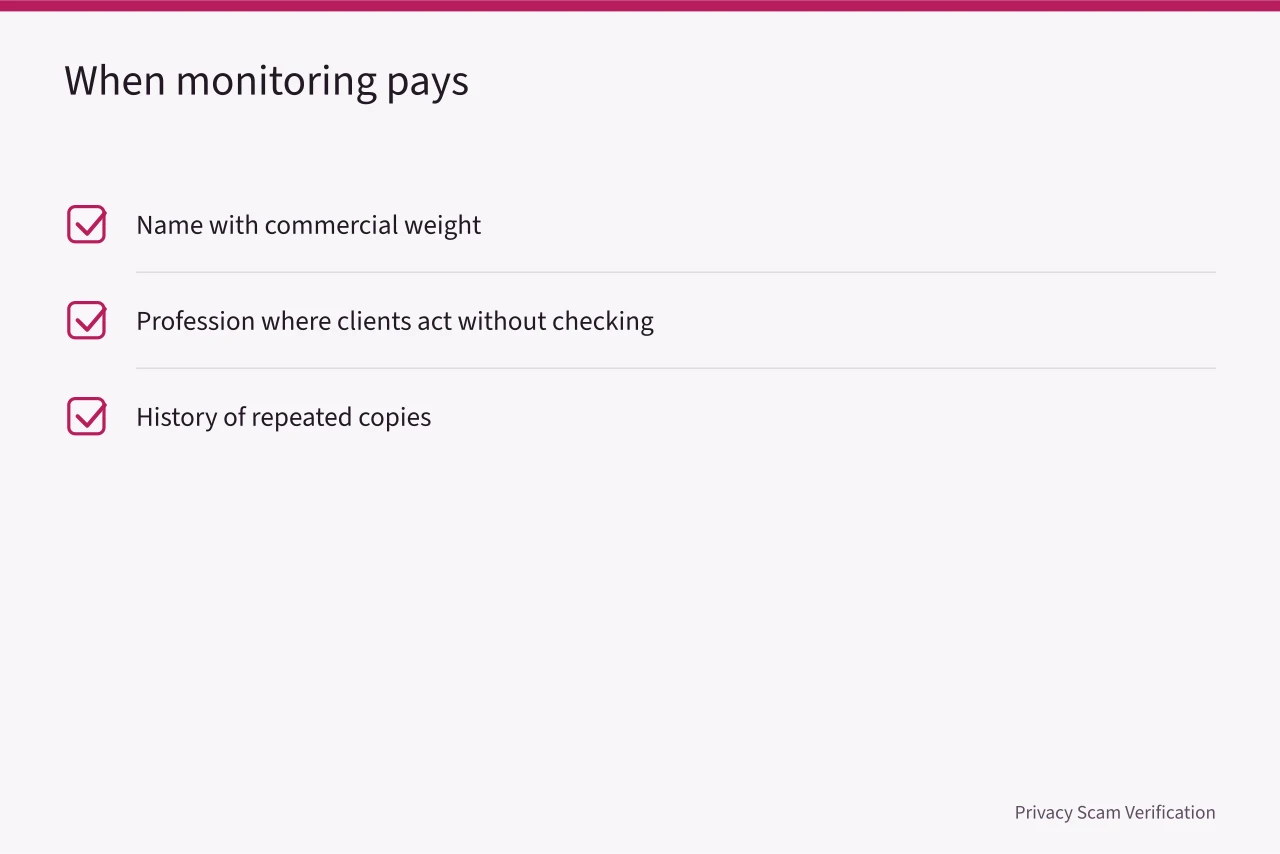
A name with commercial weight, where a copy costs customers rather than friends. A profession where a client would act on your message without checking. A history of repeated copies, each new one appearing after the last is removed.
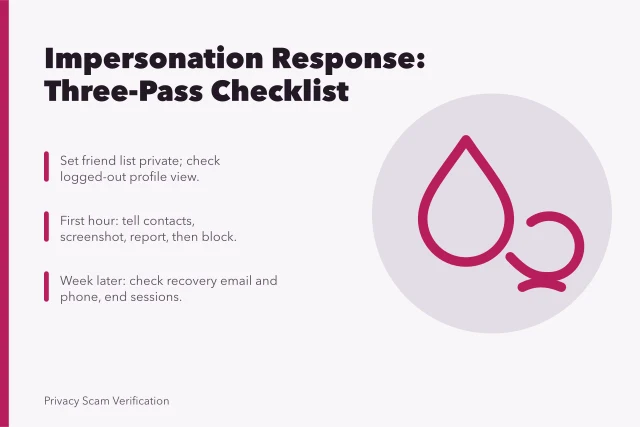
In those cases early notice is worth money. The whole benefit of finding a copy is the hours before people believe it. Everyone else gets more from the four habits above and from the response sequence in impersonation risks, which puts warning your contacts ahead of everything else.
Common questions
Is a paid monitoring service worth it for an ordinary person?
Usually not. The four free habits close more, and an alert only helps if you were going to act on it quickly. Buy monitoring when a copy would cost you customers or clients, not when it would cost you embarrassment. LifeLock Standard and Incogni both publish prices, so a household can compare them without a call.
Do verification badges mean an account is real?
They mean something happened once. Depending on the service, a badge can reflect a payment, a business relationship, or a check made years ago on an account that has since changed hands. A badge is not a statement about who is running the account today.
Can anything stop my photos being copied?
No. You can limit what is visible to people who do not follow you, and you can make a copy less useful by keeping your contacts list private. Prevention is not on the menu, which is why the habits above focus on making a copy fail rather than stopping it.
Someone offered to get a fake account removed for a fee. Is that ever legitimate?
Treat an unsolicited offer as part of the incident. The report they would file is the one you can file, and the platform does not charge for it. If you have already paid, contact your card issuer and your state attorney general's consumer protection office.